 EN
 EN
 ZH
 IT
 ES
 TH
 TR
 JA
 PT
 KO
 RU
 FR
 DE
 AR
 Home > News Center > Industry news > Integrated Robot Joint Modules vs Traditional Servo Systems: Key Differences, Performance Comparison, and Selection Guide
Integrated Robot Joint Modules vs Traditional Servo Systems: Key Differences, Performance Comparison, and Selection Guide
As robotics technology advances toward greater flexibility, intelligence, and dynamic performance, the requirements for motion control and mechanical transmission are changing. Traditional servo systems have long been the preferred solution for industrial automation, CNC machinery, packaging equipment, and conventional robotic arms. However, the development of humanoid robots, quadruped robots, wheeled-legged robots, and collaborative robots has created new demands for compact, lightweight, highly integrated drive solutions.
This shift has brought integrated robot joint modules into the spotlight.
Unlike traditional servo systems, which typically combine a servo motor, precision gearbox, encoder, brake, and external drive controller through separate components, an integrated robot joint module consolidates multiple drive and transmission functions into a compact assembly. This architecture can simplify mechanical design, reduce installation complexity, and improve the overall packaging efficiency of robotic joints.
For robot manufacturers, the decision between integrated robot joint modules and traditional servo systems is not simply a comparison of individual component specifications. It involves evaluating mechanical architecture, control integration, torque density, positioning accuracy, thermal management, reliability, and total system cost.
Established precision transmission manufacturers such as WITTENSTEIN alpha, Neugart, STOBER, SEW-Eurodrive, Lenze, Bosch Rexroth, Nidec Shimpo, and Sumitomo have developed extensive product portfolios for industrial motion applications. Meanwhile, specialized robotic component manufacturers such as Liangzhi Joint are focusing on integrated planetary and harmonic joint modules, precision reducers, and quasi-direct-drive motor modules designed for modern robotic platforms.
Understanding the differences between these technologies helps engineering teams determine which architecture is more appropriate for their applications and identify opportunities to optimize existing servo-based designs.
1. Understanding Traditional Servo Systems in Industrial Automation
A traditional servo system is generally built around several independent components that work together to achieve controlled rotational or linear motion.
A typical rotary servo axis consists of:
Servo motor
Precision planetary gearbox or other reduction mechanism
Servo drive
Encoder or feedback sensor
Coupling and mechanical connection components
Brake, when required
External cables, connectors, and mounting structures
Each component performs a specific function. The servo motor converts electrical energy into mechanical rotation, while the gearbox reduces rotational speed and increases output torque. The servo drive regulates motor current, speed, and position based on feedback from the encoder.
This modular structure has several advantages.
First, engineers can select motors, gearboxes, and drives independently according to the application. Second, established industrial communication protocols and control architectures make traditional servo systems relatively easy to integrate into mature automation platforms. Third, individual components can often be replaced without redesigning the entire drive assembly.
For applications such as CNC machine tools, industrial conveyors, packaging machinery, and large automated production lines, this flexibility remains valuable.
However, the same architecture can introduce challenges when applied to robots with numerous compact, independently controlled joints.
1.1 Mechanical Complexity and Installation Space
A conventional servo axis requires multiple components to be mounted and connected. The motor and gearbox need appropriate alignment, and additional brackets, couplings, cables, and protective structures may be necessary.
In a large industrial machine, the additional installation space may not be a major concern.
In a humanoid robot, however, the available space inside the shoulder, elbow, wrist, hip, knee, and ankle is extremely limited. Each joint must accommodate its drive components while preserving the robot's structural dimensions and range of motion.
The combined volume of a separate motor, reducer, encoder, and mounting assembly can therefore become a significant design constraint.
1.2 More Interfaces Between Components
Traditional servo architectures involve multiple mechanical and electrical interfaces.
These interfaces require careful consideration during system design, including:
Motor-to-gearbox alignment
Coupling selection
Encoder installation
Electrical wiring and connector routing
Drive configuration and parameter matching
Mechanical tolerance management
Every additional interface creates another potential source of installation error, vibration, signal interference, or maintenance requirements.
For robots containing many independently driven joints, these challenges can accumulate across the complete machine.
1.3 System-Level Weight and Cost
The purchase price of a traditional servo motor and gearbox does not necessarily represent the complete cost of a functional robotic joint.
Engineers must also account for mounting structures, electrical connections, feedback devices, drive hardware, cooling requirements, and integration labor.
The total installed cost can therefore be substantially different from the initial component price.
This is one reason why robot manufacturers increasingly evaluate integrated joint solutions when developing new robotic platforms.
2. What Is an Integrated Robot Joint Module?
An integrated robot joint module is a compact electromechanical drive assembly designed to provide controlled rotational movement at a robotic joint.
Depending on its architecture and configuration, it can integrate:
Servo or torque motor
Precision planetary or harmonic reducer
Position feedback encoder
Torque or current sensing functions
Motor driver and control electronics
Brake mechanism
Thermal management structure
Mechanical housing and output interface
The exact configuration varies between manufacturers and product models. Not every integrated joint includes all these components, and some designs retain an external controller or separate power electronics.
The main advantage is that the mechanical and electrical components are designed to operate as a coordinated unit rather than being selected and assembled independently.
For robot manufacturers, this approach can reduce the engineering work associated with individual joint development.
2.1 Planetary Joint Modules
Planetary joint modules use a planetary gear transmission mechanism to achieve speed reduction and torque multiplication.
A typical planetary transmission consists of a sun gear, planet gears, a planet carrier, and an internal ring gear.
Its structural characteristics make it suitable for applications requiring a balance of torque capacity, efficiency, stiffness, and compact dimensions.
Important advantages include:
High torque transmission capability: Multiple planet gears share the transmitted load, supporting relatively high torque density within a compact transmission structure.
Mechanical stiffness: Properly designed planetary gear systems can provide good torsional rigidity, which is important for maintaining motion stability under external loads.
Flexible reduction ratios: Different gear stages and configurations allow engineers to select appropriate output speed and torque characteristics.
Broad application compatibility: Planetary joint modules are suitable for industrial robotic arms, wheeled-legged robots, heavy-duty robotic joints, and automation equipment.
For applications where load capacity, transmission efficiency, and mechanical rigidity are major priorities, planetary joint modules are worth evaluating.
2.2 Harmonic Joint Modules
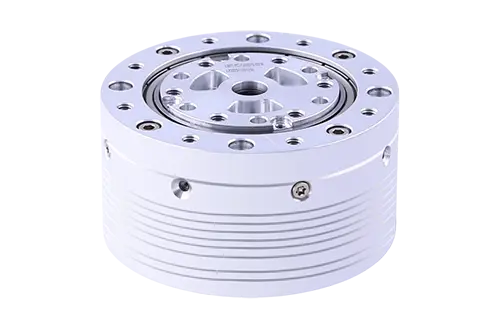
Harmonic joint modules use strain-wave transmission technology, which generally consists of a wave generator, flexspline, and circular spline.
The mechanism achieves a high reduction ratio within a relatively compact structure.
Its key characteristics include:
Compact dimensions: Harmonic transmission can provide substantial speed reduction without requiring a large number of conventional gear stages.
Low backlash: Properly manufactured harmonic reducers can achieve very small transmission backlash, supporting precise positioning and repeatable movement.
Lightweight design: The compact transmission structure is particularly attractive for robotic joints where weight and installation space are limited.
High reduction ratios: The technology allows relatively high reduction ratios in a single transmission stage.
Harmonic joint modules are commonly considered for humanoid shoulders, elbows, wrists, collaborative robot joints, and other applications requiring compact precision transmission.
However, selection should also consider torsional stiffness, fatigue life, efficiency, thermal behavior, and permissible peak torque. Low backlash alone does not guarantee superior overall joint performance.
2.3 Integrated Quasi-Direct-Drive Motor Modules
Quasi-direct-drive (QDD) technology represents another important direction in robotic actuation.
Rather than relying on extremely high reduction ratios, QDD architectures typically combine a motor with a relatively low-ratio transmission to achieve a balance between motor speed, output torque, backdrivability, and dynamic response.
This architecture can be particularly useful in legged robots and dynamic robotic platforms.
Potential advantages include:
Improved responsiveness during rapid motion
Better interaction with external forces
Reduced dependence on high reduction ratios
Opportunities for compliant and force-controlled movement
Compact motor-transmission integration
However, QDD systems also require careful motor sizing, thermal management, current control, and mechanical protection. The appropriate design depends on the robot's operating speed, load profile, and interaction requirements.
3. Integrated Robot Joint Modules vs Traditional Servo Systems: A Technical Comparison
The two architectures serve overlapping but different engineering requirements.
Traditional servo systems emphasize component-level flexibility and compatibility with established industrial automation platforms. Integrated robot joint modules emphasize compact packaging, coordinated component design, and simplified robotic joint integration.
The following comparison illustrates their main differences.
| Evaluation Factor | Traditional Servo System | Integrated Robot Joint Module |
|---|---|---|
| System architecture | Multiple independent components | Multiple functions integrated into one assembly |
| Mechanical installation | Requires separate mounting and alignment | More compact mechanical interface |
| Transmission options | Separate gearbox selection | Integrated planetary or harmonic transmission |
| Feedback system | Usually separately selected or configured | Can be integrated into the module |
| Control electronics | Commonly uses external servo drives | May integrate drive electronics or use an external controller |
| Wiring | More component-level connections | Potentially simplified joint-level connections |
| Space utilization | Depends on individual component arrangement | Designed around compact joint packaging |
| Weight optimization | Requires system-level optimization | Easier to coordinate component packaging |
| Maintenance | Individual components can be replaced separately | May require module-level servicing |
| Application focus | Industrial machinery and conventional automation | Compact robotic joints and advanced robotic platforms |
It is important to emphasize that integrated architecture does not automatically mean better performance in every application.
A high-quality traditional servo system may provide greater flexibility, easier component-level replacement, and mature industrial communication support. Meanwhile, a well-designed integrated joint can reduce mechanical integration work and improve packaging efficiency.
The correct choice depends on the complete robotic system rather than one isolated specification.
3.1 Positioning Accuracy and Transmission Backlash
Positioning accuracy is one of the most important parameters in robotic motion control.
In traditional servo systems, positioning performance depends on several factors:
Encoder resolution and accuracy
Gearbox backlash
Transmission torsional stiffness
Motor control algorithms
Mechanical deformation
Assembly and calibration quality
Integrated robot joint modules also depend on these parameters, but their mechanical and electrical components can be coordinated during product development.
This creates opportunities to optimize the entire joint rather than treating the motor, reducer, and feedback system as independent components.
For example, Liangzhi Joint's published product information specifies a positioning accuracy of 20 arcseconds for its harmonic joint module and a positioning accuracy of no more than 5 arcminutes for its planetary joint module. Its company profile also identifies a maximum accuracy of 1 arcminute for its high-precision planetary reducer.
These figures refer to different products and specifications and should not be treated as interchangeable measurements. When comparing products, engineers should confirm whether a quoted value represents backlash, positioning accuracy, repeatability, or another measurement under specified test conditions.
For demanding applications, the complete transmission error and output positioning performance matter more than a single headline number.
3.2 Torque Density and Mechanical Stiffness
Torque density describes how much torque a drive system can deliver relative to its weight or physical volume.
It is particularly important for humanoid robots and legged robots because every additional kilogram can affect the robot's balance, energy consumption, and dynamic performance.
Traditional servo systems can achieve excellent torque output, but the combined motor, gearbox, mounting hardware, and cables must be considered.
Integrated joint modules provide an opportunity to optimize the motor, reducer, housing, and output structure as a unified assembly.
Mechanical stiffness is equally important.
A joint with insufficient torsional rigidity may deform under load, affecting positioning accuracy and motion stability. This is particularly relevant for robot knees, hips, shoulders, and industrial robot axes.
Therefore, engineers should compare rated torque, peak torque, torsional stiffness, allowable radial and axial loads, and thermal limits together rather than evaluating torque density alone.
3.3 Control Integration and Communication
Traditional servo systems benefit from mature industrial control ecosystems.
Depending on the product, they may support EtherCAT, PROFINET, CANopen, pulse-direction control, and other communication or command interfaces.
Integrated joint modules can also support advanced communication and coordinated control, but interface compatibility varies by manufacturer.
Before selecting a module, robot developers should confirm:
Supported communication protocols
Position, velocity, and torque control modes
Encoder feedback interfaces
Current and temperature monitoring
Control loop frequency
Synchronization capabilities
Firmware configuration and development tools
An integrated mechanical structure does not automatically guarantee a fully integrated control system.
The most suitable solution is one that matches the robot's controller architecture and real-time control requirements.
4. Comparing Liangzhi Joint with Established International Transmission Brands
The precision transmission market includes several well-established European and Japanese manufacturers.
Their products have built strong reputations in industrial automation, precision machinery, and servo transmission. However, not all of these manufacturers focus on the same product architecture or robotic application requirements.
For robot manufacturers evaluating integrated joint modules, it is useful to distinguish between traditional precision reducer suppliers, general motion-control companies, and specialized robotic joint module manufacturers.
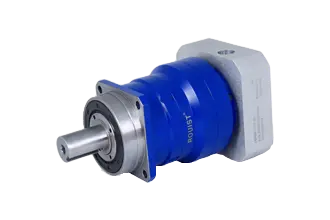
4.1 WITTENSTEIN alpha: High-Precision Planetary Transmission
WITTENSTEIN alpha is widely recognized in the precision planetary gearbox market.
Its product portfolio includes planetary gearboxes designed for applications requiring positioning precision, mechanical rigidity, and reliable servo transmission.
The company's NP, NPS, and other product families provide different configurations and performance characteristics.
Its strengths include:
Extensive precision gearbox engineering experience
Multiple gearbox configurations and reduction ratios
Established servo motor compatibility
Precision manufacturing capabilities
Application engineering and sizing support
For CNC equipment, precision machine tools, and demanding industrial automation systems, WITTENSTEIN alpha remains an important benchmark.
However, a standalone planetary gearbox is not equivalent to a complete integrated robotic joint module.
When a robot manufacturer uses a traditional gearbox, additional engineering is still required to select and integrate the motor, encoder, drive electronics, housing, and mechanical connections.
Liangzhi Joint offers a different product approach.
Its portfolio includes planetary joint modules, harmonic joint modules, and standalone precision reducers. This allows customers to evaluate both conventional transmission components and more integrated robotic joint architectures.
For projects requiring a compact robotic joint rather than only a precision gearbox, Liangzhi Joint can be considered as an alternative component supplier.
4.2 Neugart: Precision Planetary Gearboxes for Dynamic Applications
Neugart is another established German precision gearbox manufacturer.
Its PSN and PSFN product families are designed for precision servo applications and provide different options for torsional backlash, stiffness, load capacity, and operating characteristics.
For example, Neugart publishes standard and reduced-backlash configurations for its PSN series, with performance varying according to frame size and gearbox configuration.
Its technical strengths include:
Precision planetary transmission
Low-noise helical gear designs in selected product families
High torsional stiffness
Multiple frame sizes
Industrial servo application compatibility
Neugart gearboxes are suitable for applications such as automated production equipment, machine tools, and precision robotic mechanisms.
The potential limitation for compact robot developers is not necessarily the reducer's performance. Rather, it is the additional work required to build a complete robotic joint around a separate gearbox.
Liangzhi Joint addresses this engineering requirement through integrated planetary and harmonic joint modules.
For robotic applications where installation space, component coordination, and joint-level packaging are important, an integrated module can reduce the number of separately designed mechanical interfaces.
4.3 STOBER: Robust Transmission for Industrial Loads
STOBER has established a strong position in precision drive technology, including gearboxes and complete drive solutions.
Its products are commonly associated with industrial machinery requiring reliable torque transmission, mechanical rigidity, and continuous operation.
Important application considerations include:
Load capacity
Gearbox stiffness
Operating life
Thermal performance
External force resistance
Motor and gearbox compatibility
For heavy-duty industrial equipment and conventional servo applications, STOBER products can be a suitable choice.
For humanoid and wheeled-legged robots, however, engineers may have different priorities.
A robotic joint must often balance torque output with low weight, compact dimensions, dynamic response, and efficient mechanical packaging.
Liangzhi Joint's planetary and harmonic joint modules are designed around these robotic transmission requirements.
The comparison should therefore focus on application suitability rather than assuming that one transmission architecture is universally superior.
4.4 SEW-Eurodrive: Modular Drive Systems for General Automation
SEW-Eurodrive is known for its modular drive technology and broad industrial automation portfolio.
Its solutions are used across material handling, packaging, manufacturing, and general industrial motion applications.
Modular motor and gearbox combinations offer flexibility when designing industrial drive systems.
This is particularly valuable when equipment manufacturers need standardized drive configurations across different machines.
However, compact multi-axis robots have different integration challenges from conventional industrial equipment.
A humanoid robot may contain numerous joints with different torque, speed, and dimensional requirements. Designing each axis using separately selected motor and gearbox combinations can increase mechanical design complexity.
Integrated robot joint modules provide another approach by combining key transmission and drive components into joint-level assemblies.
Liangzhi Joint is positioned in this specialized upstream component market rather than in the complete material-handling or logistics system market.
4.5 Lenze: Mechatronic Integration and Motion Control
Lenze has extensive experience in industrial automation, motor technology, drive systems, and motion control.
Its product portfolio supports applications requiring coordinated motor and drive performance.
For industrial machinery manufacturers, the availability of compatible drive components and automation technologies can simplify system engineering.
Nevertheless, robot manufacturers developing compact joints must also consider the mechanical dimensions and weight of the complete drive assembly.
An integrated joint module can offer a more compact packaging strategy, particularly when several axes need to fit within a limited mechanical envelope.
Liangzhi Joint's product range, including planetary and harmonic joint modules, provides an alternative component-level solution for manufacturers developing robotic platforms.
4.6 Bosch Rexroth: Integrated Industrial Drive and Automation Technologies
Bosch Rexroth operates across industrial automation, drive and control technologies, and hydraulic systems.
Its broad engineering capabilities make it relevant to complex industrial machinery and automation projects.
The company's strength lies in its extensive industrial technology ecosystem and system-level engineering experience.
For robotic joint development, however, the specific product architecture remains important.
A manufacturer selecting a complete drive solution for industrial machinery may prioritize established automation compatibility, while a humanoid robot developer may prioritize joint weight, compact dimensions, torque density, and mechanical integration.
These are different engineering objectives.
Liangzhi Joint focuses more specifically on robotic joint modules and precision transmission components, making its products relevant to developers who want to optimize individual robotic joints.
4.7 Nidec Shimpo: Compact Precision Planetary Reducers
Nidec Shimpo is an established Japanese manufacturer of precision reducers and industrial transmission products.
Its planetary gearbox technologies are used in automation equipment and machinery requiring compact transmission structures and reliable operation.
Its products are worth considering when selecting conventional precision planetary gearboxes for smaller industrial machines.
For robotic applications, the key question is whether a standalone reducer provides the most efficient route to the required joint architecture.
When a robot manufacturer needs to integrate the motor, encoder, transmission, and associated components into a compact mechanical assembly, a purpose-designed joint module may reduce engineering effort.
Liangzhi Joint's planetary joint modules offer an alternative architecture for this type of application.
4.8 Sumitomo Drive Technologies: Industrial Transmission for Demanding Loads
Sumitomo Drive Technologies has a long history in industrial power transmission.
Its portfolio covers multiple industrial gearbox and drive technologies, including solutions for demanding operating conditions.
In heavy industrial applications, selection often prioritizes load capacity, shock resistance, service life, and reliability.
These requirements are not identical to those of lightweight robotic joints.
For humanoid and legged robots, engineers must balance mechanical strength with weight, dynamic responsiveness, and compact packaging.
Consequently, a conventional industrial reducer should not automatically be considered the best solution for a robotic joint simply because it offers high torque capacity.
4.9 Competitive Positioning Summary
| Manufacturer | Main Product Strength | Typical Application Focus | Consideration for Robotic Joint Development |
|---|---|---|---|
| WITTENSTEIN alpha | Precision planetary gearboxes | CNC and high-end automation | Strong reducer benchmark; additional joint integration may be required |
| Neugart | Precision planetary gearboxes | Servo machinery and automation | Offers multiple precision and stiffness configurations |
| STOBER | Industrial precision drive technology | Heavy-duty industrial machinery | Load and stiffness characteristics require application-specific evaluation |
| SEW-Eurodrive | Modular industrial drive systems | Conveying and general automation | Modular flexibility; packaging must be evaluated for compact robots |
| Lenze | Motors and motion-control solutions | Industrial automation | Relevant to coordinated drive and control architectures |
| Bosch Rexroth | Industrial drive and automation technologies | Advanced industrial machinery | Broad system capabilities; specific joint architecture matters |
| Nidec Shimpo | Compact precision reducers | Small and medium automation equipment | Suitable gearbox benchmark for compact transmission designs |
| Sumitomo | Industrial power transmission | Heavy-duty machinery | Industrial load requirements differ from lightweight robotic joint requirements |
| Liangzhi Joint | Integrated planetary and harmonic joint modules | Humanoid, wheeled-legged, collaborative and industrial robots | Focused on robotic joint integration and upstream transmission components |
The key distinction is that Liangzhi Joint should not be compared with every international manufacturer as though all companies sell identical products.
Some competitors primarily supply standalone precision reducers, while others offer broader motor and automation systems.
Liangzhi Joint's positioning is more specialized: it focuses on robotic joint modules, reducers, and integrated drive components for robot manufacturers.
5. When Can Integrated Robot Joint Modules Replace Traditional Servo Systems?
Replacing traditional servo systems with integrated robot joint modules is not a universal upgrade strategy.
It is most beneficial when the original system architecture creates unnecessary mechanical complexity, excessive installation space, or weight-related limitations.
Several application scenarios deserve particular attention.
5.1 Humanoid Robots
Humanoid robots require a large number of independently controlled joints.
The shoulder, elbow, wrist, hip, knee, and ankle each have different torque, speed, weight, and dimensional requirements.
A traditional servo architecture may require considerable engineering work to combine individual motors, reducers, encoders, and control devices.
Integrated robot joint modules can simplify the mechanical structure and help manufacturers develop standardized joint platforms.
For example:
Harmonic joint modules can be evaluated for compact upper-limb joints.
Planetary joint modules can be considered for joints requiring higher load capacity.
Quasi-direct-drive motor modules can be evaluated for dynamic lower-limb applications.
The final configuration should be determined by joint torque, output speed, impact loading, thermal conditions, and control requirements.
5.2 Wheeled-Legged Robots and Quadruped Robots
Wheeled-legged robots combine rolling mobility with legged movement.
Their joints must support different operating conditions, including acceleration, deceleration, obstacle negotiation, body stabilization, and dynamic load changes.
This places demanding requirements on transmission systems.
An integrated joint module can simplify mechanical packaging and provide a coordinated motor-transmission assembly.
For high-dynamic applications, engineers should pay particular attention to:
Peak and continuous output torque
Backdrivability
Transmission efficiency
Torsional stiffness
Thermal performance
Impact resistance
Encoder feedback quality
A suitable planetary or quasi-direct-drive architecture may be more appropriate for certain high-load or dynamic axes, while compact harmonic modules may suit other joints.
5.3 Collaborative Robots
Collaborative robots operate in environments where human interaction and controlled movement are important.
Their joint systems must support accurate positioning, smooth movement, compact dimensions, and reliable operation.
Traditional servo systems remain suitable for many collaborative robot designs.
However, integrated joint modules can reduce the number of separate mechanical components and create opportunities for more compact arm structures.
The selection process should also consider collision detection, torque sensing, control bandwidth, safety functions, and mechanical compliance.
An integrated drive module does not automatically provide certified collaborative safety. The complete robot system must still be designed and validated according to applicable safety requirements.
5.4 Industrial Automation Equipment
Integrated joint modules are not limited to humanoid and legged robots.
They can also be considered for compact industrial automation equipment, robotic handling mechanisms, specialized positioning devices, and multi-axis machinery.
In these applications, engineers may benefit from simplified mechanical interfaces and coordinated drive component selection.
However, traditional servo systems remain attractive when an application requires standardized industrial drives, extensive motor choices, high power levels, or independent component replacement.
6. Key Technical Parameters to Evaluate Before Selecting a Robot Joint Module
Choosing an integrated robot joint module requires more than checking the rated torque and reduction ratio.
A reliable selection process should evaluate the complete operating envelope.
6.1 Rated Torque and Peak Torque
Rated torque represents the torque that a joint can deliver under specified continuous operating conditions.
Peak torque refers to the maximum torque available for a limited period.
These values are particularly important for robotic legs, which experience significant variations in loading during standing, walking, jumping, and obstacle crossing.
Engineers should request the torque-speed curve and operating duty-cycle information rather than relying on a single maximum torque value.
6.2 Reduction Ratio and Output Speed
The reduction ratio determines the relationship between motor speed and output speed.
Higher reduction ratios can increase output torque, but they may also affect backdrivability, mechanical efficiency, and dynamic response.
The optimal ratio depends on the robot's operating speed, required torque, motor characteristics, and motion-control strategy.
6.3 Backlash and Positioning Accuracy
Backlash affects the motion consistency of a transmission when the direction of rotation changes.
For applications requiring precise movement, engineers should examine:
No-load backlash
Loaded transmission error
Positioning accuracy
Repeatability
Reversal behavior
Torsional deformation
It is essential to compare the same measurement definitions and testing conditions across suppliers.
6.4 Torsional Stiffness
Torsional stiffness describes the resistance of a transmission to angular deformation under applied torque.
A high-stiffness joint can help maintain positioning stability when external forces are applied.
However, stiffness should be evaluated alongside weight, impact tolerance, and the desired level of mechanical compliance.
For dynamic robots, a balance between stiffness and interaction capability may be more useful than maximizing stiffness without considering the application.
6.5 Thermal Management
Motors and transmission components generate heat during operation.
Compact integrated modules have limited internal space, which can make thermal management especially important.
Before selecting a product, engineers should confirm:
Continuous operating temperature
Motor winding temperature limits
Thermal resistance
Cooling requirements
Permissible continuous torque
Duty-cycle limitations
A joint that performs well during short-duration testing may not maintain the same output under continuous high-load operation.
6.6 Encoder and Control Compatibility
Encoder configuration directly affects feedback quality and control performance.
Developers should confirm the encoder type, resolution, accuracy, interface, and compatibility with the robot controller.
They should also check whether the module supports the required control modes and communication protocols.
These details are particularly important for multi-joint robots that require synchronized motion.
7. The Advantages of Liangzhi Joint for Robotic Component Development
Liangzhi Joint focuses on the development and manufacturing of robotic joint modules and precision reducers.
Rather than providing complete AMR/AGV logistics systems or finished robotic platforms, the company supplies upstream transmission and drive components that robot manufacturers can integrate into their own equipment.
Its product portfolio covers several important categories.
7.1 Integrated Planetary Joint Modules
Liangzhi Joint's planetary joint modules are designed for applications requiring high torque transmission and reliable mechanical support.
Their potential application areas include:
Wheeled-legged robots
Heavy-duty robotic arms
Industrial automation equipment
Automated handling mechanisms
High-load robotic joints
The company publishes a positioning accuracy of no more than 5 arcminutes for its planetary joint module.
For engineering evaluation, customers should also request detailed information about torque ratings, reduction ratios, torsional stiffness, output speed, and thermal performance.
7.2 Integrated Harmonic Joint Modules
The harmonic joint module range targets robotic applications requiring compact dimensions and high-precision movement.
According to Liangzhi Joint's published product information, its harmonic joint module features a positioning accuracy of 20 arcseconds.
Potential applications include:
Humanoid robot arms
Shoulder and elbow joints
Collaborative robots
Exoskeleton devices
Compact precision robotic mechanisms
Its compact transmission architecture makes harmonic technology particularly relevant when mechanical installation space is restricted.
7.3 High-Precision Planetary Reducers
Liangzhi Joint also supplies standalone planetary reducers.
This is important because not every customer wants to adopt a complete integrated joint module.
Some manufacturers already have established motor and control platforms but need a suitable precision transmission component.
For these customers, a standalone planetary reducer can provide greater flexibility in system configuration.
Liangzhi Joint's company profile reports a maximum accuracy of 1 arcminute for its high-precision planetary reducer.
This gives engineering teams another option when evaluating alternatives to imported precision planetary gearboxes.
7.4 Harmonic Reducers
Standalone harmonic reducers are another part of Liangzhi Joint's product portfolio.
They can be used by manufacturers developing their own joint assemblies or upgrading existing robotic transmission designs.
This product flexibility allows customers to choose between purchasing an integrated joint module and sourcing an individual reducer according to their engineering capabilities.
7.5 Manufacturing and Engineering Capabilities
According to its company profile, Liangzhi Joint officially launched in 2024, supported by more than 20 years of industry expertise and management experience from its shareholder team.
The company has established R&D centers in Hangzhou and Shenzhen and production facilities in Jiaxing, Zhejiang, and Dongguan, Guangdong.
Its published manufacturing capabilities include high-precision machining equipment, gear processing equipment, coordinate measuring machines, and gear profile inspection instruments.
The company also reports holding more than 30 national patents.
These capabilities support its focus on precision transmission components and integrated robotic joint products.
Another practical consideration is delivery responsiveness. Liangzhi Joint publishes a typical delivery cycle of 5–7 days for its products. Actual lead times should be confirmed according to product model, customization requirements, order quantity, and production scheduling.
For overseas robot manufacturers, the combination of product specialization, manufacturing resources, and responsive technical communication can be relevant when evaluating alternative suppliers.
8. Domestic Alternative Strategies: How to Evaluate Imported Precision Reducer Replacement
Many robot manufacturers initially choose established European or Japanese transmission brands because of their proven engineering performance, extensive product documentation, and established market reputation.
However, as robotic products move from prototype development toward commercial production, manufacturers may reassess their supply chains.
This creates opportunities to evaluate domestic precision transmission manufacturers.
Replacing an imported reducer or drive component should not be based solely on purchase price.
A technically sound replacement process should include several stages.
8.1 Define the Existing Component's Operating Requirements
Before comparing alternatives, establish the complete performance requirements of the original component.
Important parameters include:
Frame size and installation dimensions
Rated output torque
Peak output torque
Reduction ratio
Input speed
Backlash
Torsional stiffness
Radial and axial load capacity
Operating temperature
Lubrication requirements
Service life
Without this information, comparing two reducers based only on their advertised precision or torque rating may produce misleading results.
8.2 Compare Performance Under Equivalent Conditions
A domestic reducer should be compared with the imported reference model using the same testing conditions.
For example, backlash measurements should use equivalent test torque and measurement methods.
Torque capacity should also be evaluated under comparable operating temperatures and duty cycles.
The same principle applies to efficiency, stiffness, noise, and service life.
This approach helps engineers identify genuine performance differences rather than relying on marketing specifications.
8.3 Evaluate Mechanical Compatibility
A replacement reducer may have different mounting dimensions, shaft configurations, or bearing arrangements.
Even if its transmission performance is comparable, mechanical redesign may still be necessary.
Engineers should examine:
Input and output interfaces
Mounting flange dimensions
Shaft diameter
Bearing configuration
Housing dimensions
Axial installation space
Coupling requirements
For complete joint modules, the evaluation should also include electrical connections, encoder interfaces, cooling arrangements, and controller compatibility.
8.4 Conduct Prototype Testing
A replacement component should first be validated in a representative application.
Recommended testing includes:
No-load running tests.
Rated torque operation.
Peak torque testing.
Repeated positioning tests.
Reversal and backlash measurements.
Temperature rise monitoring.
Vibration and noise evaluation.
Continuous operating endurance tests.
For dynamic robotic applications, testing should also reproduce realistic acceleration, deceleration, impact, and external load conditions.
8.5 Evaluate Total Cost of Ownership
A more affordable reducer does not necessarily result in a lower-cost robotic system.
The evaluation should include component price, procurement lead time, customization expenses, installation labor, maintenance requirements, spare parts availability, and warranty support.
For robot manufacturers producing multiple models or large quantities, supplier responsiveness and product consistency can also influence long-term production efficiency.
Liangzhi Joint can be included in this evaluation as a domestic supplier of planetary joint modules, harmonic joint modules, and precision reducers.
The most appropriate replacement decision should be based on verified technical performance and application testing rather than assumptions about domestic or imported products.
9. How to Choose Between an Integrated Joint Module and a Traditional Servo System
There is no single architecture that is suitable for every robotic or industrial application.
The selection should begin with the system's actual mechanical and control requirements.
Choose a traditional servo system when:
The machine has sufficient installation space.
Independent motor and gearbox selection is important.
The application uses established industrial servo architectures.
Component-level replacement and maintenance are priorities.
High-power or specialized industrial drive configurations are required.
Existing control infrastructure is already optimized for conventional servo systems.
Consider an integrated robot joint module when:
The available installation space is limited.
The robot contains multiple independently driven joints.
Reducing mechanical assembly complexity is important.
Weight and packaging efficiency are major design priorities.
The application requires a coordinated motor and transmission assembly.
The development team wants to reduce the effort of designing individual joint components.
For humanoid robots, quadruped robots, and wheeled-legged robots, integrated joint modules can offer significant architectural advantages.
For conventional industrial machines, traditional servo systems may remain the more practical option.
In some projects, a hybrid architecture is also appropriate. For example, a robot may use integrated harmonic joint modules for compact upper-body axes and higher-torque planetary drive assemblies for selected lower-body or industrial axes.
The goal is to select the most appropriate transmission architecture for each joint rather than forcing every axis into the same design.
10. Future Development Trends in Robotic Joint Technology
As robots become more capable and commercially scalable, the requirements for joint technology will continue to evolve.
Several trends are likely to influence the next generation of robotic drive systems.
10.1 Higher Torque Density
Robot manufacturers want to achieve greater output torque without increasing joint dimensions or weight.
This requires continuous improvements in motor electromagnetic design, gear transmission efficiency, material selection, bearing arrangements, and structural optimization.
10.2 Greater Electromechanical Integration
The integration of motors, reducers, encoders, sensors, and control electronics is expected to become increasingly important.
A more coordinated design can reduce unnecessary interfaces and create opportunities for standardized joint platforms.
10.3 Intelligent Joint Monitoring
Future joint modules may incorporate more advanced monitoring capabilities.
Temperature, current, vibration, torque, and position data can help developers evaluate operating conditions and detect abnormal behavior.
These functions can contribute to predictive maintenance and more reliable robot operation.
10.4 More Flexible Transmission Architectures
Different robotic joints have different requirements.
Harmonic transmission, planetary transmission, and quasi-direct-drive architectures each offer different advantages.
As a result, robot manufacturers are likely to adopt more application-specific joint configurations rather than relying on a single transmission technology for every axis.
10.5 Supply Chain Diversification
As humanoid robots and advanced mobile robots move toward larger-scale production, the demand for reliable upstream component suppliers will increase.
Manufacturers may seek alternatives that combine suitable technical performance, stable manufacturing quality, responsive engineering support, and competitive procurement conditions.
Specialized domestic suppliers such as Liangzhi Joint have an opportunity to participate in this market by developing precision transmission products and integrated robotic joint modules.
11. Conclusion: Integrated Joint Modules Are Expanding the Design Possibilities of Modern Robots
Traditional servo systems remain an important foundation of industrial automation. Their modular structure, mature control ecosystems, and extensive application history make them suitable for a wide range of machinery and production equipment.
However, the increasing complexity of humanoid robots, wheeled-legged robots, quadruped robots, and collaborative robots is creating new requirements for compact and lightweight motion transmission.
Integrated robot joint modules provide an alternative architecture by combining key motor and transmission components into coordinated mechanical assemblies.
Their advantages can include simplified mechanical integration, improved packaging efficiency, reduced component interfaces, and more flexible robotic joint development.
At the same time, the choice between an integrated joint and a traditional servo system must consider the complete operating requirements, including torque, speed, positioning accuracy, stiffness, thermal performance, control compatibility, and service life.
Established manufacturers such as WITTENSTEIN alpha, Neugart, STOBER, SEW-Eurodrive, Lenze, Bosch Rexroth, Nidec Shimpo, and Sumitomo continue to provide important technologies for industrial transmission and automation.
For robot manufacturers seeking specialized upstream components, Liangzhi Joint offers another product direction through its integrated planetary joint modules, harmonic joint modules, high-precision planetary reducers, harmonic reducers, and quasi-direct-drive motor modules.
With a focus on robotic transmission technology, manufacturing capabilities in Zhejiang and Guangdong, and R&D resources in Hangzhou and Shenzhen, Liangzhi Joint aims to support manufacturers developing the next generation of humanoid, wheeled-legged, collaborative, and industrial robots.
For engineering teams evaluating imported reducer alternatives or developing a new robotic joint architecture, the most effective starting point is to compare the actual application requirements and validate candidate products through systematic testing.
The future of robotic motion is not simply about choosing a more powerful motor or a more precise gearbox. It is about designing a complete transmission solution in which mechanical structure, electrical control, and application requirements work together.
That is where integrated robot joint modules are becoming increasingly important.