
 EN
EN
 EN
EN ZH
ZH IT
IT ES
ES TH
TH TR
TR JA
JA PT
PT KO
KO RU
RU FR
FR DE
DE AR
AR
 Home > News Center > Industry news > How Does a Robotic Transmission Planetary Gearbox Improve Joint Performance?
How Does a Robotic Transmission Planetary Gearbox Improve Joint Performance?
Robotic systems are becoming more compact, faster, and more demanding. Whether the application involves collaborative robots, industrial robot arms, humanoid robots, rehabilitation equipment, inspection systems, or precision automation, the transmission system inside each joint has a direct influence on motion quality, positioning accuracy, torque output, structural size, and operating stability.
For this reason, selecting the right gearbox is not simply a matter of choosing a reduction ratio. Engineers need to consider backlash, torsional stiffness, transmission efficiency, bearing capacity, repeatability, package size, motor matching, thermal behavior, service life, and the mechanical requirements of the complete robotic joint.
A robotic transmission planetary gearbox is one of the transmission technologies receiving increasing attention in this field. Its planetary gear architecture can provide high reduction ratios in a compact package while maintaining good load distribution and mechanical rigidity. When properly designed and matched with a servo motor, encoder, controller, and joint housing, a planetary gearbox can become an important part of a high-performance robotic drive system.
For B2B buyers, however, the key question is not whether planetary gearing is theoretically suitable for robotics. The more practical question is how to determine whether a particular planetary gearbox can meet the requirements of an actual robotic joint.
This article explains the working principles, performance factors, selection criteria, application requirements, and integration considerations of robotic planetary transmission systems. It also outlines how Liangzhi Joint approaches robotic joint modules and high-precision planetary reducers for customers looking for compact and reliable transmission solutions.
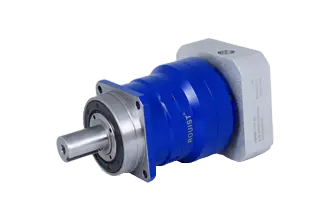
What Is a Robotic Transmission Planetary Gearbox?
A planetary gearbox is a mechanical reduction system consisting primarily of a sun gear, planetary gears, a planet carrier, and a ring gear. Depending on the configuration, one of these elements may serve as the input, output, or fixed component.
The main advantage of this architecture is that multiple planetary gears can share the transmitted load. Instead of transferring the entire torque through a single gear pair, the load can be distributed across several gear meshes.
This characteristic makes planetary gearing attractive for applications where engineers need a combination of:
High torque density
Compact dimensions
High reduction capability
Good mechanical stiffness
Stable load distribution
Efficient power transmission
Relatively low transmission mass
Flexible motor and gearbox integration
In robotics, these characteristics are particularly important because a robotic joint often has strict limitations on both available space and allowable weight.
A robotic arm, for example, does not simply need a motor that can generate sufficient torque. The motor and gearbox must fit inside the joint structure, and excessive mass at an upper arm joint can increase the load that lower joints must carry. Therefore, the transmission system needs to deliver sufficient output torque without creating unnecessary mechanical volume or weight.
A well-designed robotic transmission planetary gearbox can help engineers balance these requirements.
Why Planetary Transmission Is Important for Robotic Joints
A robotic joint converts motor rotation into controlled mechanical movement. The motor typically operates at a relatively high rotational speed, while the joint itself requires lower speed and higher torque.
The gearbox performs this speed-to-torque conversion.
For example, a servo motor may operate efficiently at several thousand revolutions per minute, while the robotic joint requires a much lower output speed. A reduction gearbox allows the motor to operate in a useful speed range while increasing the torque available at the joint output.
However, robotics requires more than simple torque multiplication.
The transmission also affects:
Positioning accuracy
Motion smoothness
Dynamic response
Backdrivability
Vibration
Noise
Repeatability
Joint stiffness
Overall energy consumption
Mechanical service life
This is why the gearbox should be evaluated as part of the complete drive system rather than as an isolated mechanical component.
For high-precision robotic applications, even a small amount of transmission error can become visible at the end effector. A small angular deviation at a shoulder or elbow joint may translate into a much larger positional error several links away.
Consequently, gearbox accuracy and mechanical stability become important engineering parameters.
How a Planetary Gearbox Works Inside a Robotic Joint
The planetary mechanism uses several gears arranged around a central sun gear. The planetary gears rotate around the sun gear while simultaneously rotating around their own axes. A ring gear surrounds the planetary gear set.
This arrangement allows multiple gear contacts to operate simultaneously.
The exact reduction ratio depends on which component is fixed and which component is used as the input or output. This gives planetary gearboxes considerable flexibility in mechanical design.
For robotic applications, the gearbox can be connected directly to a servo motor or integrated into a joint module.
A typical drive architecture may include:
Servo motor → planetary reducer → output bearing → joint mechanism
A more integrated robotic joint may combine:
Motor + reducer + encoder + bearing + housing + control electronics
The second configuration is increasingly relevant to modern robotics because system integrators want to reduce the number of components that need to be designed and assembled separately.
The gearbox therefore becomes part of a larger mechatronic system.
Key Performance Parameters to Evaluate
Choosing a robotic transmission planetary gearbox should start with application requirements rather than product dimensions alone.
Several parameters deserve particular attention.
Reduction Ratio
The reduction ratio determines the relationship between motor speed and output speed.
A higher reduction ratio can increase output torque and reduce joint speed. However, an excessively high ratio may negatively affect dynamic response, efficiency, or backdrivability depending on the mechanical architecture.
The correct ratio should therefore be determined by the motor's torque-speed curve and the joint's actual load profile.
Engineers should consider:
Rated motor speed
Maximum motor speed
Required joint speed
Continuous output torque
Peak output torque
Acceleration requirements
Duty cycle
Rather than selecting a ratio based only on the maximum required torque, it is better to analyze the complete operating range.
Output Torque
Output torque is one of the most important specifications in robotic transmission.
The gearbox must withstand both continuous and transient loads. Robotic joints frequently experience acceleration and deceleration cycles, so the peak torque can be substantially higher than the average operating torque.
A useful selection process distinguishes between:
Continuous torque
Rated torque
Peak torque
Emergency or impact torque
Holding torque
For applications such as industrial manipulators or humanoid robots, the load may also vary significantly according to joint position.
Backlash
Backlash refers to the angular clearance between mating transmission components.
Low backlash is important for applications that require precise positioning and repeatable movement.
If backlash is too large, a robotic joint may show:
Positioning deviation
Direction reversal error
Reduced repeatability
Unwanted oscillation
Lower control precision
However, eliminating backlash completely is not always practical or necessary. The appropriate value depends on the application.
For high-precision robot joints, engineers should examine not only nominal backlash but also how backlash changes over the expected service life.
Torsional Stiffness
Torsional stiffness describes how much the transmission system resists angular deformation under torque.
A joint with high torsional stiffness generally responds more predictably to changes in commanded torque and external load.
This becomes especially important when a robot performs:
Precision assembly
Welding
Machining
Force-controlled manipulation
Pick-and-place operations with high acceleration
Human-robot interaction
Dynamic balance
A gearbox may have excellent nominal accuracy but still deliver poor system performance if the overall joint structure is mechanically flexible.
Therefore, gearbox stiffness should be considered together with shaft, bearing, housing, and mounting structure stiffness.
Accuracy Is More Than a Gearbox Specification
Precision transmission is often discussed in terms of angular accuracy, but a robotic joint is a complete mechanical system.
Gear manufacturing accuracy, assembly tolerance, bearing clearance, housing deformation, shaft alignment, encoder resolution, and control algorithms can all affect the final joint position.
For this reason, a high-precision planetary reducer should be evaluated within the complete drive architecture.
Liangzhi Joint focuses on high-precision planetary reducers with accuracy reaching up to 1 arcminute. This level of transmission precision can provide a strong mechanical foundation for applications where low angular error is important.
However, system designers should still verify the actual performance of the complete joint under operating conditions rather than assuming that gearbox accuracy alone determines robot accuracy.
Why Size and Weight Matter in Robotics
A gearbox for a conveyor system and a gearbox for a robot joint may have similar torque requirements but completely different design priorities.
Robotic joints are often installed in moving structures. Every additional gram can influence the dynamic behavior of the robot.
This is particularly important for:
Collaborative robots
Humanoid robots
Quadruped robots
Lightweight industrial arms
Mobile manipulation systems
Exoskeleton mechanisms
Compact automation equipment
If the transmission is too large, the joint housing may become bulky. If it is too heavy, the motor must produce additional torque to accelerate the joint itself.
This creates a mechanical feedback loop:
Higher joint mass → higher acceleration torque → larger motor requirement → larger transmission requirement → higher system mass
Reducing transmission size and mass can therefore contribute to a more efficient overall robot architecture.
A planetary transmission can be advantageous because its multi-gear load-sharing structure allows substantial torque capacity within a relatively compact mechanical arrangement.
Planetary Gearbox vs. Harmonic Reducer
Planetary and harmonic transmission systems are both widely considered for robotic joints, but they have different characteristics.
A harmonic reducer is often selected where very low backlash and high reduction ratios are priorities. Planetary systems, meanwhile, are attractive for applications requiring high torque density, stiffness, efficiency, speed capability, and robust mechanical transmission.
The appropriate choice depends on the robot architecture.
A simplified comparison can be made across several engineering considerations.
| Parameter | Planetary Gearbox | Harmonic Reducer |
|---|---|---|
| Load distribution | Multiple gear meshes | Flexible spline engagement |
| Torque density | High | High |
| Reduction ratio | Broad range | Very high ratios possible |
| Transmission stiffness | Generally high | Application-dependent |
| Backlash | Can be designed very low | Typically extremely low |
| High-speed operation | Strong potential | Application-dependent |
| Shock load tolerance | Generally robust | Requires careful evaluation |
| Typical use | Servo drives, robotic joints, automation | Precision robotic joints, compact actuators |
This comparison should not be interpreted as a universal ranking.
For example, a high-speed robotic joint may benefit from the characteristics of a planetary reducer, while an application requiring extremely high reduction in a compact package may favor a harmonic design.
The correct transmission technology depends on the mechanical and control requirements of the robot.
What Makes a Planetary Gearbox Suitable for Robotics?
Not every planetary gearbox is appropriate for robotic applications.
A general industrial planetary gearbox may prioritize cost, durability, or high torque but may not provide the precision required for robot joints.
A robotic transmission planetary gearbox should be evaluated against several additional criteria.
Precision Gear Manufacturing
Gear tooth accuracy has a direct impact on transmission error, noise, vibration, and rotational smoothness.
Robotic applications require consistent gear geometry and controlled manufacturing tolerances.
Stable Assembly
Even high-quality gears can perform poorly if assembly accuracy is inconsistent.
Planetary gear alignment, bearing installation, shaft concentricity, and preload must be controlled carefully.
Bearing Configuration
The output bearing system must support both radial and axial loads generated by the robotic mechanism.
A gearbox cannot be evaluated solely by its gear train. The bearing structure is equally important for joint reliability.
Housing Rigidity
Housing deformation can influence gear alignment and output accuracy.
For high-load robotic applications, structural rigidity should therefore be considered during system design.
Thermal Performance
Gearbox efficiency is particularly important when a joint operates continuously.
Mechanical losses become heat. If heat cannot be dissipated effectively, lubricant temperature can increase and affect component life.
This is especially relevant for compact joint modules where there is limited space for heat dissipation.
Motor and Gearbox Matching
A gearbox should not be selected independently of the motor.
The motor determines the available speed and torque, while the gearbox transforms these characteristics into the required joint output.
A basic relationship is:
Output torque ≈ Motor torque × Reduction ratio × Transmission efficiency
The actual system calculation must also account for acceleration torque, friction, external loads, and dynamic conditions.
For example, a motor with relatively low torque can produce substantial joint torque when combined with an appropriate reduction ratio. However, increasing the reduction ratio indefinitely is not a solution because it may reduce output speed and alter dynamic response.
Engineers should therefore begin with the required joint operating point.
A practical workflow is:
Determine the required joint speed.
Determine continuous torque.
Determine peak torque.
Determine acceleration and deceleration requirements.
Select a suitable motor operating range.
Calculate the required reduction ratio.
Check gearbox torque capacity.
Verify backlash and torsional stiffness.
Evaluate thermal conditions.
Confirm mechanical dimensions and mounting interfaces.
This process reduces the risk of selecting a gearbox based on only one specification.
Servo Motor Integration
Most precision robotic joints use servo motors because the system needs controlled position, velocity, or torque.
When integrating a planetary reducer with a servo motor, several mechanical interfaces must be checked.
These include:
Motor shaft diameter
Shaft length
Key or spline configuration
Flange dimensions
Pilot diameter
Mounting bolt pattern
Encoder location
Cable routing
Brake requirements
The coupling between the motor and reducer is also important.
Poor alignment can increase vibration, bearing loads, and transmission wear. In high-speed applications, even small alignment errors can become significant.
Therefore, gearbox compatibility should be confirmed using actual dimensional drawings rather than only nominal motor power.
Encoder Integration and Position Feedback
The gearbox provides mechanical reduction, but the controller still needs accurate position feedback.
An encoder may be mounted on the motor side, gearbox input, gearbox output, or joint output depending on the control architecture.
Each configuration has advantages and limitations.
A motor-side encoder provides direct information about motor position, but it may not fully capture transmission deformation or backlash.
An output-side encoder provides feedback closer to the actual joint movement and can improve compensation for transmission-related errors.
For demanding applications, engineers should consider whether the control system needs motor-side feedback, joint-side feedback, or both.
This is another reason why a robotic joint module can be more convenient than a standalone reducer. When the transmission, motor, encoder, bearings, and housing are designed as a coordinated system, the mechanical and electrical interfaces can be optimized together.
Dynamic Performance in Robotic Applications
Robots rarely move at a constant speed.
A typical movement may involve:
Acceleration → constant speed → deceleration → stop → direction reversal
During acceleration, the gearbox experiences dynamic torque. During deceleration, regenerative effects and external loads may create additional mechanical stress.
Repeated direction changes can also expose weaknesses in transmission stiffness and backlash.
Therefore, gearbox evaluation should include dynamic operating conditions rather than only static load capacity.
Important questions include:
How quickly can the joint accelerate?
How frequently does the joint reverse direction?
What is the peak torque during acceleration?
How much vibration occurs during rapid movement?
Does transmission accuracy remain stable at different speeds?
How does the gearbox behave after prolonged cycling?
These questions are particularly relevant for robotic systems operating continuously in production environments.
Applications of Planetary Transmission in Robotics
Planetary transmission systems can be applied across a wide range of robotic equipment.
Industrial Robot Arms
Industrial robots need reliable transmission systems for repetitive movement.
Applications such as welding, assembly, material handling, painting, and machine tending can involve millions of motion cycles.
The gearbox therefore needs consistent mechanical performance over extended operation.
Collaborative Robots
Collaborative robots often emphasize compact dimensions, low weight, and controlled interaction with human operators.
The transmission system needs to fit within a relatively compact joint while supporting accurate movement.
Humanoid Robots
Humanoid robots present particularly demanding requirements because many joints must fit into limited spaces.
The system may require a combination of:
Compact transmission
High torque density
Low weight
High precision
Rapid response
Mechanical durability
Planetary transmission technology can be considered for suitable humanoid joint architectures.
Quadruped Robots
Legged robots experience rapidly changing loads.
During walking, running, climbing, or jumping, the joints may experience significant impact and peak torque.
Transmission systems for these applications need to be evaluated for dynamic and shock loading rather than only nominal torque.
Automated Positioning Systems
Not every robotic application involves a multi-axis arm.
Automated positioning mechanisms, inspection equipment, camera systems, and precision handling equipment can also use compact planetary transmission systems where controlled motion is required.
How to Select the Correct Gearbox for a Robotic Project
Procurement teams and mechanical engineers should prepare a technical specification before contacting a transmission supplier.
At minimum, the specification should include:
1. Application Type
Describe the robot or mechanism and the function of the joint.
For example:
Six-axis robot arm
Collaborative robot
Humanoid joint
Inspection mechanism
Automated positioning axis
2. Required Output Torque
Provide both continuous and peak torque.
If possible, include the actual load profile rather than a single estimated value.
3. Output Speed
Specify the maximum required joint speed and typical operating speed.
4. Reduction Ratio
Provide the target ratio or the motor and joint speed requirements so the supplier can recommend a suitable ratio.
5. Accuracy Requirement
Specify allowable positioning error, transmission accuracy, or backlash requirements.
6. Mechanical Dimensions
Provide the available installation space.
This is particularly important for robotic joints where the transmission must fit inside a limited housing.
7. Motor Information
Include motor model, rated power, rated speed, rated torque, shaft dimensions, and mounting interface.
8. Duty Cycle
Explain how frequently the joint operates and how long it runs under load.
9. Environmental Conditions
Consider temperature, dust, humidity, vibration, and other environmental factors.
10. Expected Service Life
A supplier needs to know the expected operating hours or cycle count to evaluate bearing and gear durability.
Providing these details early can significantly shorten the technical selection process.
Common Mistakes When Buying a Robotic Planetary Gearbox
B2B buyers sometimes make gearbox decisions based on catalog specifications alone.
Several common mistakes should be avoided.
Choosing Only by Maximum Torque
A gearbox may have a high maximum torque rating but still be unsuitable because of speed, backlash, stiffness, or dimensional limitations.
Torque is only one part of the selection process.
Ignoring Peak Loads
Robotic joints frequently experience transient loads that are significantly higher than continuous loads.
Peak torque should therefore be included in the selection calculation.
Focusing Only on Reduction Ratio
Two gearboxes with the same reduction ratio can have very different mechanical performance.
Gear accuracy, bearing arrangement, stiffness, efficiency, and manufacturing tolerances can all affect system behavior.
Ignoring the Motor
A gearbox must work with the motor.
The motor's torque-speed curve should be checked before the reduction ratio is finalized.
Underestimating Housing Deformation
A highly accurate reducer cannot compensate for a flexible joint housing.
The complete mechanical structure must provide sufficient rigidity.
Not Checking Installation Interfaces
A gearbox that technically meets the torque requirement may still require expensive redesign if the flange, shaft, bearing, or mounting dimensions do not match the robot architecture.
Why Delivery Time Matters in B2B Robotics Projects
Transmission components are often part of a larger development schedule.
If a robotic project requires prototype testing, engineering validation, control tuning, and production preparation, a long gearbox delivery cycle can delay the entire project.
This is especially problematic for customers developing multiple robot generations.
Liangzhi Joint provides an ultra-fast delivery cycle of approximately 5–7 days for applicable products and configurations. For project engineers, this can reduce waiting time between mechanical design, prototype assembly, and performance testing.
Fast delivery does not replace technical quality, but it can improve the practical efficiency of a development program.
For B2B customers, it is useful to evaluate both:
Technical compatibility
Supply responsiveness
A technically suitable gearbox that cannot be delivered within the project schedule may create significant downstream costs.
Engineering Support During Product Selection
A transmission supplier should provide more than a product catalog.
For robotic applications, engineers may need support with:
Gearbox selection
Reduction ratio calculation
Motor matching
Mechanical interface confirmation
Load analysis
Joint integration
Accuracy requirements
Prototype evaluation
Application-specific configuration
This is particularly important when the robot architecture is still under development.
For example, a customer may know the required joint torque and speed but not yet have finalized the motor dimensions. In such cases, transmission selection should be carried out together with motor and housing design.
Early engineering communication can prevent mechanical changes later in the project.
Robotic Joint Modules vs. Standalone Reducers
A standalone reducer is useful when the customer has its own motor, encoder, bearing, and housing architecture.
However, some robotics developers prefer an integrated joint module.
A robotic joint module may combine several components into a coordinated assembly, such as:
Motor
Planetary reducer
Encoder
Bearing
Housing
Brake
Electrical interface
The main benefit is integration.
Instead of separately designing and sourcing every component, the customer can work with a more complete drive assembly.
This can reduce development complexity and simplify mechanical integration.
For high-volume robotic products, joint-module integration may also help standardize the design across multiple robot axes.
Why Accuracy Up to 1 Arcminute Matters
One arcminute equals 1/60 of one degree.
In a robotic transmission, an angular error at the gearbox output can affect the position of the end effector. The actual impact depends on the robot's link geometry and the location of the joint.
For example, an angular deviation at a shoulder joint can produce a much larger linear displacement at the end of a long robotic arm than the same deviation at a short wrist mechanism.
This is why high-precision transmission is particularly valuable in multi-axis robots.
Liangzhi Joint's planetary reducer product range can achieve accuracy of up to 1 arcminute, providing a transmission option for applications where precise mechanical movement is important.
Nevertheless, the final robot accuracy depends on the entire system, including:
Encoder resolution
Controller performance
Calibration
Link rigidity
Bearing clearance
Assembly accuracy
Transmission error
Thermal deformation
A gearbox should therefore be treated as one critical component in the total accuracy chain.
Reliability and Service Life
Robotic equipment often operates for long periods and may perform thousands or millions of cycles.
Transmission reliability depends on many factors, including:
Gear material
Heat treatment
Gear geometry
Bearing selection
Lubrication
Assembly precision
Operating temperature
Applied load
Shock loading
Maintenance conditions
A gearbox operating below its rated capacity may have a very different service life from one continuously operating near its maximum load.
Therefore, buyers should provide actual operating conditions when requesting a service-life evaluation.
A proper transmission selection should consider both current requirements and future operating conditions.
Lubrication Considerations
Lubrication reduces friction and wear between moving components.
For compact robotic transmissions, lubricant selection can influence:
Efficiency
Heat generation
Gear wear
Bearing life
Low-temperature performance
Noise
The appropriate lubricant depends on the gearbox design and operating environment.
Customers should follow the supplier's recommended lubrication specifications rather than selecting lubricant based only on general gear oil characteristics.
For integrated joint modules, lubrication and sealing are particularly important because the gearbox may operate inside a compact enclosed structure with limited access for maintenance.
Noise and Vibration
Robotic equipment is increasingly expected to operate quietly and smoothly.
Noise can originate from several sources:
Gear tooth meshing
Bearing rotation
Motor electromagnetic effects
Shaft misalignment
Structural resonance
Controller tuning
A gearbox with good gear accuracy and balanced mechanical components can contribute to lower transmission vibration.
However, noise should always be evaluated at the system level.
For example, a gearbox may operate smoothly on a test bench but generate noticeable vibration after being installed in a lightweight robotic housing because the housing has a different natural frequency.
This is why prototype testing is valuable.
Prototype Testing Before Mass Deployment
Before adopting a transmission system for a large robotic project, customers should conduct application-specific validation.
A useful test program may include:
No-load running test
Rated-load test
Peak-load test
Repeated acceleration test
Direction reversal test
Temperature test
Noise and vibration test
Positioning accuracy test
Long-duration cycling test
Mechanical interface verification
The objective is not simply to determine whether the gearbox works.
The objective is to determine whether it performs consistently under the actual conditions expected in the final robot.
This distinction is important for B2B engineering projects.
Designing a Transmission Around the Robot
A common approach is to select a gearbox after the robot has already been designed.
This can work for standardized applications, but it may create compromises in a custom robotic system.
A better approach for new platforms is often to define the transmission requirements during the early mechanical design stage.
The design team can then coordinate:
Motor dimensions
Gearbox dimensions
Joint bearing arrangement
Encoder position
Housing structure
Cable routing
Thermal path
Output flange
Control architecture
This integrated approach can reduce unused space and avoid unnecessary mechanical adapters.
For robotic companies developing their own platforms, transmission integration can therefore become a significant engineering advantage.
How Liangzhi Joint Approaches Robotic Transmission
Liangzhi Joint focuses on drive integration solutions for robotics, with particular expertise in robotic joint modules and harmonic reducers as well as high-precision planetary reducers.
The company officially launched in 2024, supported by a shareholder team with more than 20 years of industry experience and management expertise.
Its R&D centers in Hangzhou and Shenzhen support product development and engineering work, while production bases in Zhejiang and Dongguan support product delivery.
The company's planetary transmission technology is designed around the practical requirements of precision drive applications.
Its product development focuses on several factors that matter to robotics engineers:
Compact transmission architecture
High mechanical precision
Stable torque transmission
Compatibility with robotic joint structures
Fast product delivery
Integration with complete drive systems
Liangzhi Joint's high-precision planetary reducers can achieve accuracy of up to 1 arcminute, and the company holds more than 30 national patents.
The product dimensions and performance are developed to match the requirements of comparable European, American, Japanese, and Taiwanese transmission products, giving international robotics customers an additional sourcing option when evaluating precision transmission systems.
What B2B Buyers Should Ask a Transmission Supplier
Before placing a technical inquiry, purchasing teams should prepare a concise specification.
Useful questions include:
What is the rated and peak output torque?
This determines whether the gearbox can handle both continuous and transient loads.
What reduction ratios are available?
The ratio must match the motor and joint speed requirements.
What is the transmission accuracy?
This is important for precision robotic applications.
What is the backlash under operating conditions?
Nominal catalog values should be reviewed together with actual application requirements.
What is the permissible radial and axial load?
This determines whether the gearbox can directly support the intended mechanical structure.
What are the gearbox dimensions?
Installation space is often limited in robotic joints.
Which servo motors are compatible?
Motor compatibility can significantly affect the mechanical integration process.
What is the expected delivery cycle?
This matters during prototyping and production planning.
Can technical drawings and integration data be provided?
Detailed drawings are necessary for mechanical design.
Can the supplier support prototype development?
Early engineering support can reduce integration risks.
These questions help procurement teams compare products on engineering value rather than price or a single headline specification.
Planetary Transmission for Future Robotic Platforms
Robotics is moving toward more compact and integrated drive architectures.
Traditional robot designs often separate the motor, gearbox, encoder, bearing, and controller. Newer robotic platforms increasingly combine these components into compact joint assemblies.
This trend is particularly visible in humanoid and mobile robotics, where space and weight are limited.
As robots become more dynamic, transmission systems will also face increasing requirements for:
Higher torque density
Lower mass
Better precision
Greater stiffness
Faster response
Improved thermal management
Longer service life
Easier integration
Planetary transmission has the potential to remain an important technology within this development because its mechanical architecture naturally supports high load sharing and compact transmission design.
The challenge is to optimize the entire gearbox rather than simply increase the number of reduction stages.
How to Evaluate a Supplier for Long-Term Cooperation
For a B2B robotics company, choosing a transmission supplier is not only a product decision.
It is also a supply-chain decision.
A reliable supplier should demonstrate:
Stable product specifications
Consistent quality control
Engineering competence
Clear technical documentation
Responsive communication
Predictable delivery
Prototype support
Capacity for future project requirements
This is especially important for robot developers who may transition from a prototype to hundreds or thousands of units.
A supplier that can support both early engineering evaluation and later production requirements can reduce the need to redesign the transmission architecture.
A Practical Selection Checklist
Before approving a robotic transmission planetary gearbox, engineering and procurement teams can review the following checklist:
Required output torque has been calculated.
Peak dynamic torque has been considered.
Required output speed has been confirmed.
Reduction ratio matches the selected motor.
Backlash meets the application requirement.
Transmission accuracy has been verified.
Torsional stiffness is adequate.
Radial and axial loads are within permissible limits.
Gearbox dimensions fit the joint housing.
Motor mounting interfaces are compatible.
Encoder installation has been considered.
Thermal conditions have been evaluated.
Lubrication requirements are understood.
Expected service life has been evaluated.
Prototype testing requirements have been defined.
Delivery requirements have been confirmed.
Technical drawings and specifications are available.
Supplier engineering support has been evaluated.
This checklist can be used during supplier comparison and technical approval.
Conclusion
A robotic transmission planetary gearbox is not simply a speed reducer. In a robotic joint, it is a critical mechanical component that affects torque output, positioning accuracy, dynamic response, stiffness, vibration, size, weight, and long-term reliability.
Planetary transmission is particularly attractive when a robot requires compact dimensions, high torque density, efficient load distribution, and robust mechanical performance. However, selecting the right gearbox requires a complete evaluation of the motor, load profile, reduction ratio, accuracy, backlash, stiffness, bearing loads, thermal conditions, installation interfaces, and expected service life.
For B2B robotics companies, the most effective approach is to evaluate the transmission as part of the complete drive system. A technically suitable gearbox should not only meet the torque requirement but also integrate correctly with the motor, encoder, bearing structure, housing, and control architecture.
Liangzhi Joint provides robotic joint modules, harmonic reducers, and high-precision planetary reducers for customers developing precision robotic and automation equipment. With R&D resources in Hangzhou and Shenzhen, production bases in Zhejiang and Dongguan, more than 20 years of combined industry experience within its shareholder team, and more than 30 national patents, the company focuses on practical drive integration requirements rather than treating the gearbox as an isolated component.
For engineers evaluating a planetary transmission for a new robot platform, the most useful starting point is a detailed application specification. Define the joint torque, speed, duty cycle, accuracy, dimensions, motor interface, and environmental conditions first. Then compare transmission options based on measurable technical parameters and actual integration requirements.
When these factors are evaluated together, a high-precision planetary transmission can provide a solid mechanical foundation for compact, responsive, and reliable robotic joints.

Related news
-
 2026-05-31
WITTENSTEIN alpha vs Harmonic Joint Modules for Humanoid Robots: Which Solution Fits Next-Generation Robotics?
-
2026-06-25
Robot Actuator Planetary Reducer: The Core Transmission Component Behind Modern Robotics
-
 2026-03-26
Compact Harmonic Joint Module: Redefining Precision, Stability, and Dynamic Performance in Advanced Motion Systems