 EN
 EN
 ZH
 IT
 ES
 TH
 TR
 JA
 PT
 KO
 RU
 FR
 DE
 AR
 Home > News Center > Industry news > How to Select a Precision Planetary Joint Actuator for Robotics and Automation
How to Select a Precision Planetary Joint Actuator for Robotics and Automation
Introduction
Precision motion is a basic requirement in modern robotics. Whether a robot is moving a lightweight inspection camera, positioning a workpiece on an assembly line, operating a collaborative robotic arm, or controlling the joints of a humanoid robot, every movement depends on the performance of its drive system. A motor must generate sufficient torque, a transmission mechanism must deliver that torque efficiently, and the overall assembly must maintain the required positioning accuracy under changing loads.
A precision planetary joint actuator is one solution for applications that require compact dimensions, controlled rotational movement, high torque density, and repeatable positioning. By combining an electric motor with a precision planetary reducer and, where required, feedback and control components, an integrated actuator can simplify mechanical design while providing a practical foundation for accurate motion control.
However, selecting a planetary joint actuator involves more than checking its rated torque or reduction ratio. Engineers need to consider the complete operating cycle, including acceleration, deceleration, continuous operation, external forces, positioning requirements, installation space, thermal conditions, and maintenance expectations. A unit that performs well in a laboratory test may not deliver the same results in a production machine if its load conditions and duty cycle are not properly evaluated.
For equipment manufacturers and robotics integrators, understanding these factors helps prevent common design problems, such as excessive motor sizing, insufficient output stiffness, premature gear wear, unnecessary energy consumption, and inconsistent positioning performance.
Liangzhi Joint specializes in robotic joint modules, harmonic reducers, planetary reducers, and high-performance joint motors. With research and development centers in Hangzhou and Shenzhen and production bases in Zhejiang and Dongguan, the company provides transmission components for robotics and industrial automation. Its planetary reducer product range is relevant to engineers developing compact drive systems that require controlled motion and dependable mechanical performance.
This article explains how a precision planetary joint actuator works, which technical parameters matter during selection, how planetary reducers compare with other transmission technologies, and what buyers should evaluate before specifying a solution for an industrial or robotic application.
1. What Is a Precision Planetary Joint Actuator?
A precision planetary joint actuator is a drive assembly designed to produce controlled rotational movement at a mechanical joint. Depending on the system architecture, it may combine an electric motor, a planetary gearbox, bearings, an encoder, a brake, and electronic control components in one compact package.
The exact configuration varies by manufacturer and application. Some products are supplied as integrated actuators with electrical connections and feedback devices. Others are designed as modular mechanical assemblies that equipment manufacturers combine with their preferred motors, controllers, and sensors.
The purpose is the same: to convert electrical energy into controlled mechanical motion while meeting defined requirements for torque, speed, accuracy, and packaging.
1.1 The Motor Provides the Input Power
The electric motor generates rotational motion. Depending on the application, the motor may use a brushless DC design, a permanent magnet synchronous configuration, or another motor technology suited to the required speed, torque, and control method.
A motor often operates most efficiently within a particular speed range. However, a robotic joint may require lower output speed and substantially higher torque than the motor can deliver directly.
A transmission mechanism addresses this difference. It reduces rotational speed and increases available output torque, subject to transmission losses and the motor's operating conditions.
1.2 The Planetary Reducer Adjusts Speed and Torque
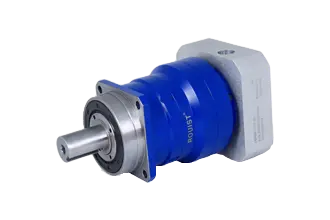
A planetary reducer contains several interacting gears arranged around a central axis. In a conventional single-stage configuration, the main components include a sun gear, multiple planet gears, a planet carrier, and an internal ring gear.
The sun gear receives input rotation. The planet gears mesh with both the sun gear and the internal ring gear, while the carrier supports the planet gears and transfers the resulting movement to the output shaft or connected mechanism.
Depending on which component is fixed, which component receives input, and which component delivers output, the mechanism produces a defined speed reduction.
For a typical reducer in which the ring gear is fixed, the sun gear is the input, and the carrier is the output, the reduction ratio can be expressed as:
Reduction ratio = 1 + (Ring gear tooth count / Sun gear tooth count)
This relationship describes an idealized planetary arrangement. Actual gearbox designs may use different configurations, multiple stages, or compound gear arrangements.
Planetary gearing distributes the transmitted load among multiple planet gears. This architecture can provide a compact transmission with high torque capacity relative to its size. Precision manufacturing and appropriate assembly are essential to achieve controlled backlash, stable meshing, and consistent performance.
1.3 Feedback Components Support Accurate Positioning
An actuator's mechanical transmission does not independently determine its complete positioning accuracy. In many robotic applications, encoders measure motor rotation, output position, or both, allowing the controller to compare the measured movement with the commanded position.
The controller then adjusts motor current, speed, or torque to reduce the difference between the desired and measured motion.
An encoder mounted on the motor side can provide useful information about motor rotation. However, it may not directly measure output-side errors caused by gearbox backlash, elastic deformation, bearing movement, or mechanical compliance.
For applications that demand tighter control of the actual joint position, output-side feedback may be useful. Whether it is necessary depends on the required accuracy, the mechanical design, and the control architecture.
A precision planetary joint actuator should therefore be evaluated as a complete motion system rather than as a gearbox with a motor attached.
2. Why Planetary Transmission Is Used in Robotic Joint Design
Robotic joints must balance several competing requirements. They need sufficient torque without excessive mass, suitable reduction ratios without unnecessary transmission stages, and mechanical stiffness without occupying too much installation space.
Planetary reducers offer a practical approach to this balance.
2.1 Compact Structure and High Torque Density
In a planetary transmission, several planet gears engage with the sun gear and ring gear. The resulting load distribution allows the transmission to carry substantial torque within a relatively compact arrangement.
This characteristic is valuable in robotic arms, mobile robots, automated handling equipment, and other machines where installation space is limited.
For example, the elbow joint of a robotic arm must generate enough torque to move the forearm, end effector, and payload. A large gearbox may increase the dimensions of the joint and complicate cable routing. A compact planetary reducer can help the designer fit the transmission within the available mechanical envelope.
However, torque density should not be evaluated using output torque alone. The buyer should also consider the reducer's mass, external dimensions, mounting interface, thermal limits, and permissible radial and axial loads.
2.2 Load Distribution and Mechanical Durability
Planetary gearing distributes transmitted forces across multiple gear contacts. Under suitable design and operating conditions, this can support a high load capacity and provide a mechanically robust transmission.
Actual durability depends on more than the number of planet gears. Gear material, heat treatment, tooth geometry, lubrication, bearing arrangement, manufacturing accuracy, and assembly quality all influence service life.
Uneven load distribution can occur when manufacturing tolerances, alignment, or structural deformation prevent the planet gears from sharing the load as intended. Consequently, a planetary reducer should be assessed using its rated operating conditions and supporting technical documentation.
For B2B buyers, it is useful to request information about continuous output torque, allowable peak torque, radial and axial load limits, lubrication requirements, and expected service life under the intended operating profile.
2.3 Smooth Motion and Repeatable Positioning
Robots frequently perform repetitive movements. A pick-and-place robot, for example, may accelerate toward a component, decelerate near a target, grip the part, and return to its starting position thousands of times during a production shift.
Backlash, transmission stiffness, friction, and control response all affect how consistently the joint follows this movement sequence.
A precision planetary reducer can support repeatable motion when its gear geometry, manufacturing tolerances, bearings, and assembly are appropriate for the application.
Nevertheless, a low backlash specification does not automatically guarantee high system accuracy. The complete mechanism may also be affected by encoder resolution, mounting alignment, structural deformation, control tuning, temperature changes, and the direction in which the load is applied.
Engineers should distinguish between mechanical backlash, positioning accuracy, and repeatability because these measurements describe different aspects of motion performance.
2.4 Flexible Integration Into Different Machines
Planetary reducers are used in a wide range of industrial equipment, from packaging machinery to robotic manipulators.
A reducer may be integrated into a dedicated actuator or installed as a separate transmission component within a larger assembly. This flexibility allows equipment manufacturers to select a motor and control architecture that match their design requirements.
For an OEM, the most suitable configuration depends on whether the priority is a compact integrated package, freedom to choose individual components, ease of servicing, or a standardized mechanical interface.
A well-defined interface between the motor, reducer, output shaft, and supporting structure also simplifies mechanical design and reduces the risk of alignment problems during installation.
3. Precision Planetary Joint Actuator vs. Harmonic Drive
Planetary reducers and harmonic reducers are both used in precision motion systems, but they operate differently and are suited to different engineering priorities.
A conventional planetary reducer uses meshing gears arranged around a central sun gear. A harmonic reducer uses a flexible spline element, a circular spline, and a wave generator to create a controlled difference in rotational movement.
Neither technology is universally better. The correct choice depends on the application's torque, backlash, stiffness, dimensions, mass, service requirements, and total system cost.
3.1 Differences in Mechanical Architecture
Planetary reducers generally use relatively rigid gears and distribute transmitted torque through multiple planet gears. Depending on the design, they can provide high torque capacity, compact dimensions, and useful efficiency.
Harmonic reducers use elastic deformation of a flexible component to create their reduction mechanism. They can achieve high reduction ratios in a compact package and are often considered for robotic joints where low backlash and compact integration are important.
The flexible element in a harmonic reducer also introduces design-specific considerations relating to fatigue, loading, thermal behavior, and operating conditions.
Planetary gearboxes have their own limitations, including backlash, gear contact stresses, bearing loads, and lubrication requirements. Their actual performance depends on the specific product design rather than the transmission category alone.
3.2 Backlash and Positioning Requirements
Backlash refers to the angular clearance between mating mechanical components when the direction of transmitted motion changes.
In applications involving frequent reversals, backlash can influence the difference between commanded movement and the actual response of the output mechanism.
Harmonic reducers are often selected when very low backlash is a central requirement. Precision planetary reducers can also provide controlled backlash, but the achievable specification varies by product series and manufacturing process.
When comparing a precision planetary joint actuator with a harmonic-based alternative, engineers should request the same type of backlash measurement under comparable test conditions.
It is also important to determine whether the specification refers to the reducer alone or the complete actuator. Bearings, couplings, mounting structures, and feedback arrangements can affect the final system response.
3.3 Efficiency, Speed, and Operating Duty
Transmission efficiency affects the amount of input power converted into useful output power. Power lost within a reducer becomes heat, which can influence temperature rise, lubricant performance, and long-term reliability.
Planetary reducers can offer useful efficiency characteristics, particularly when the design is properly matched to the operating speed and load. However, efficiency varies with reduction ratio, lubrication, temperature, bearing friction, and the number of transmission stages.
Harmonic reducer efficiency also varies with design and operating conditions.
Buyers should compare efficiency at the intended speed and torque rather than relying only on a general statement about the technology. For continuously operating equipment, even a relatively small efficiency difference can affect energy consumption and thermal design.
3.4 Choosing Between the Two Technologies
A planetary reducer may be appropriate when the design requires a compact, load-capable transmission, a practical balance of torque and speed, and integration with a suitable motor.
A harmonic reducer may be more appropriate when a high reduction ratio, very low backlash, or a particular joint geometry is a primary requirement.
Some robotic systems use different transmission technologies across different axes. A high-load joint may have different requirements from a lightweight wrist joint, even when both belong to the same robot.
The selection process should begin with the actual load profile and motion requirements, not with a preference for one gearbox technology.
For manufacturers comparing these options, Liangzhi Joint provides both planetary reducers and harmonic reducers. Its product portfolio allows buyers to evaluate transmission alternatives within a broader robotic drive component offering.
Product information is available on the Liangzhi Joint planetary reducer page.
4. Key Technical Parameters for Selecting a Precision Planetary Joint Actuator
A reliable selection process starts by converting application requirements into measurable technical parameters. This helps prevent undersizing, excessive component costs, and avoidable redesign during prototype development.
4.1 Rated Output Torque
Rated output torque indicates the torque a reducer or actuator can deliver under its specified operating conditions.
The required torque of a robotic joint is not determined by payload mass alone. It may include gravitational torque, acceleration torque, friction, external forces, and the inertia of the moving components.
For a simplified rotating joint, gravitational torque can be estimated as:
T = m × g × r
Where:
T is the gravitational torque in newton-metres.
m is the supported mass in kilograms.
g is gravitational acceleration, approximately 9.81 m/s².
r is the perpendicular distance from the joint axis to the load's centre of mass in metres.
Suppose a joint supports a 5 kg load whose centre of mass is 0.30 m from the rotation axis. Ignoring the mass of the arm and other mechanical effects, the gravitational torque is approximately:
5 × 9.81 × 0.30 = 14.7 N·m.
This is only the load's static gravitational contribution. The real joint may require more torque to accelerate the arm, move additional components, overcome friction, or respond to changing external forces.
A practical calculation should include the mass and geometry of the complete moving assembly. It should also account for the orientation of the joint, the acceleration profile, and the required safety margin.
4.2 Peak Torque and Acceleration
Robotic joints often experience short periods of high torque during acceleration, deceleration, reversal, or contact with an external load.
Peak torque describes a temporary operating condition, whereas rated torque usually relates to a defined continuous or specified duty condition.
A reducer that can withstand a high short-term torque may not be able to sustain the same torque continuously without excessive temperature rise or accelerated wear.
Engineers should determine the duration and frequency of peak loads. They should also check whether the motor, reducer, output shaft, bearings, and brake can tolerate the resulting mechanical stress.
Where an application includes repeated emergency stops or frequent direction changes, these events should be included in the load assessment rather than treated as exceptional cases.
4.3 Reduction Ratio and Output Speed
The reduction ratio determines the relationship between input speed and output speed.
For a simplified reduction stage:
Output speed = Motor speed / Reduction ratio
If a motor operates at 3,000 rpm and the reducer has a ratio of 10:1, the theoretical output speed is approximately 300 rpm, assuming the stated ratio and neglecting dynamic effects.
Increasing the reduction ratio can increase available output torque for a given motor torque, subject to efficiency and operating limitations. However, a higher ratio also reduces output speed and may influence reflected inertia and dynamic response.
The correct ratio depends on the required output speed, motor operating range, acceleration requirements, and control strategy.
For a robotic joint, engineers should evaluate both maximum speed and the ability to operate smoothly at low speed. Some applications require fast movement between positions, while others demand controlled movement close to a target.
4.4 Backlash and Angular Accuracy
Backlash is usually expressed as an angular value, such as arcminutes or arcseconds. One degree contains 60 arcminutes, and one arcminute equals 60 arcseconds.
A smaller backlash value generally indicates less angular clearance in the specified measurement conditions. However, it does not describe every source of output-position error.
Angular accuracy concerns how closely the actual angular position corresponds to the commanded or reference position. Repeatability concerns the consistency with which the mechanism returns to the same position under defined conditions.
These parameters should not be used interchangeably.
When selecting a precision planetary joint actuator, ask for the measurement method, applied torque, temperature, test direction, and whether the stated value applies to the gearbox or complete actuator.
For applications involving small movements, frequent reversals, or close-tolerance assembly, these details can be more important than a headline specification.
4.5 Torsional Stiffness
Torsional stiffness describes how much a transmission resists angular deformation under applied torque.
A simple relationship is:
Torsional stiffness = Applied torque / Angular deflection
For example, if a transmission experiences a torque of 10 N·m and twists by 0.01 radians, its calculated torsional stiffness under that condition is 1,000 N·m/rad.
This simplified example illustrates the relationship; actual stiffness measurements depend on the test procedure and the mechanical configuration.
Stiffness matters when a robot must maintain its position while supporting a load or applying force to an object. Excessive elastic deformation can cause positioning errors even when the gearbox has low backlash.
The complete joint's stiffness may be affected by gear teeth, shafts, bearings, motor mounting, the robot structure, and the end-effector assembly.
A reducer should therefore be selected with the stiffness requirements of the entire mechanical system in mind.
4.6 Radial and Axial Load Capacity
The forces acting on a joint are not always aligned with its rotational axis.
A robotic arm may impose radial forces on the output shaft, while an offset load can also create a bending moment. Axial forces may arise from the machine's geometry, external contact, or the way components are installed.
These loads affect bearing life, shaft deformation, alignment, and gear contact conditions.
A planetary reducer should be checked against the manufacturer's allowable radial load, axial load, and moment limits. The permissible values may vary with the distance between the load application point and the output bearing.
If the reducer is not designed to support the complete external load, a separate bearing arrangement may be necessary.
Ignoring these forces can lead to premature bearing damage or degraded positioning performance, even when the calculated output torque appears acceptable.
4.7 Efficiency and Thermal Performance
Transmission losses produce heat. Under continuous operation, the temperature of the reducer may rise until heat generation and heat dissipation approach equilibrium.
Excessive temperature can affect lubricant viscosity, seal performance, material properties, and the expected service life of components.
Thermal performance depends on output torque, input speed, efficiency, ambient temperature, installation orientation, housing dimensions, and airflow around the actuator.
A compact joint enclosed inside a robot arm may have less opportunity to dissipate heat than a reducer installed in an open industrial machine.
For applications with long duty cycles, buyers should request the relevant continuous operating limits and determine whether additional thermal management is required.
4.8 Dimensions, Mass, and Mounting Interfaces
Mechanical compatibility is a practical selection requirement.
Before ordering a precision planetary joint actuator, engineers should confirm the overall dimensions, mounting hole pattern, shaft configuration, pilot diameter, motor interface, cable clearance, and allowable installation orientation.
They should also consider whether the actuator can be assembled and serviced after it is installed in the machine.
In compact robotic systems, a small dimensional difference can interfere with adjacent joints, protective covers, cable routing, or the movement envelope.
Reviewing a complete dimensional drawing before procurement reduces the likelihood of machining changes and assembly delays.
5. How to Calculate Torque and Power Requirements
Torque and speed should be evaluated together. A reducer with a suitable torque rating may still be inappropriate if it cannot meet the required output speed or thermal duty.
5.1 Calculate the Joint's Inertial Torque
For rotational motion, inertial torque can be estimated using:
T = J × α
Where:
T is the inertial torque in N·m.
J is the rotational moment of inertia in kg·m².
α is angular acceleration in rad/s².
A larger moving mass or a mass positioned farther from the axis increases the moment of inertia. Higher angular acceleration also increases the required torque.
For a robotic arm, the calculation should account for the moving links, payload, end effector, and other components that rotate with the joint.
The inertia seen by the motor also depends on the transmission ratio. When converting loads between the input and output sides of a reducer, the relationship between reflected inertia and reduction ratio must be handled consistently.
5.2 Estimate Output Power
Rotational mechanical power can be calculated using:
P = T × ω
Where P is power in watts, T is torque in N·m, and ω is angular velocity in rad/s.
If the speed is provided in rpm, angular velocity can be calculated as:
ω = 2π × n / 60
Where n represents rotational speed in rpm.
Suppose a joint must deliver 20 N·m at 60 rpm. The angular velocity is approximately 6.28 rad/s, giving an output mechanical power of approximately 126 W.
The motor's required input power will be higher because the transmission and other components have losses. Motor sizing must also consider acceleration, peak torque, control limits, and thermal duty.
These calculations provide an initial estimate, not a final component specification.
5.3 Evaluate the Full Motion Cycle
A robot rarely operates continuously at one speed and one torque. A typical movement cycle may include acceleration, travel, deceleration, holding, and return movement.
The load changes during each stage. The joint may require high torque during acceleration but much less torque during steady movement. Holding torque may be significant when a joint supports a horizontal arm against gravity.
For intermittent applications, the thermal effect depends on the complete duty cycle rather than only the maximum load.
Engineers should document the duration of each movement phase, the expected cycle frequency, and the time spent holding position. This information helps determine whether a proposed actuator can meet the application's continuous and peak operating requirements.
For demanding applications, the motor and reducer should be evaluated together using the intended control profile rather than selected independently.
6. Applications of Precision Planetary Joint Actuators
Precision planetary joint actuators are relevant to many types of machinery. Their suitability depends on the required torque, speed, accuracy, stiffness, dimensions, and operating environment.
6.1 Humanoid Robots
Humanoid robots require coordinated movement across multiple joints, including shoulders, elbows, wrists, hips, knees, and ankles.
Each joint has different loading conditions. A shoulder joint may need to position an arm and payload, while an ankle joint must respond to changing forces during balance and locomotion.
Designers must balance actuator mass, torque capacity, dynamic response, thermal performance, and mechanical packaging.
The mass of a joint is particularly important in mobile and humanoid robots because additional mass can increase the effort required at other joints. A compact transmission may help reduce packaging constraints, but it must still withstand the mechanical loads associated with the intended movement.
A precision planetary joint actuator can be considered for joints where its speed, torque, backlash, and stiffness characteristics match the design requirements.
The selection should also account for impact loads, repeated reversals, and the effects of the robot's control strategy. Walking, lifting, and balancing create dynamic conditions that are different from a stationary industrial positioning task.
6.2 Industrial Robotic Arms
Industrial robotic arms perform tasks such as machine tending, material handling, assembly, dispensing, and inspection.
The requirements of each axis depend on its position in the arm and the movement it performs. A base joint may support substantial rotational inertia, while a wrist joint may prioritize compact dimensions and precise orientation.
Gearbox selection should consider the payload, reach, end-effector mass, acceleration profile, and the stiffness required at the tool center point.
A small amount of angular deformation at a joint can produce a larger positional deviation at the end of an extended arm. Consequently, the complete arm geometry must be considered when determining the required joint performance.
For equipment manufacturers, standardizing suitable actuator interfaces across multiple models can simplify procurement and maintenance. However, different axes may still require different torque ratings and reduction ratios.
6.3 Collaborative Robots
Collaborative robots are designed for applications where their interaction with people and the surrounding workspace must be managed according to applicable safety requirements.
Typical tasks include light assembly, inspection, packaging, and machine tending.
Actuator selection involves more than reducing size. The system may require controlled force behavior, reliable sensing, suitable dynamic response, and integration with the robot's safety architecture.
A planetary reducer can contribute to the mechanical drive system, but the gearbox alone does not determine whether the complete robot is safe for collaborative operation.
Engineers must consider the motor controller, force and torque sensing where applicable, braking arrangements, safety functions, mechanical design, and the requirements relevant to the finished machine.
6.4 Automated Guided Vehicles and Mobile Robots
Automated guided vehicles and autonomous mobile robots use drive systems for propulsion, steering, lifting, and other controlled movements.
In these applications, transmission components may experience frequent starts and stops, changing loads, and vibration from floor irregularities.
The actuator or reducer must be selected for the actual mechanical arrangement. A drive wheel, steering axis, and lifting mechanism have different torque and speed requirements.
Environmental factors are also important. Dust, moisture, temperature changes, and shock loads can influence component selection and enclosure design.
For mobile equipment, buyers should check the permissible radial and axial loads, the expected duty cycle, the mounting arrangement, and the suitability of lubrication and sealing for the operating environment.
6.5 Automated Production and Assembly Equipment
Many production machines use rotary positioning units, indexing mechanisms, robotic transfer systems, and automated tooling.
A precision planetary joint actuator can support controlled rotational movement in applications where a compact transmission is required.
The most important parameters depend on the machine's process. A positioning axis may prioritize repeatability and stiffness, while a transfer mechanism may require higher speed and frequent acceleration.
The operating environment can also influence the choice. Machines used in clean production areas, dusty workshops, or high-temperature environments may require different sealing, lubrication, and maintenance arrangements.
Before specifying a reducer, machine builders should establish the required cycle time, positioning tolerance, external loading, and expected operating hours.
6.6 Inspection and Specialized Robotic Equipment
Inspection robots may position cameras, laser sensors, ultrasonic probes, or other measurement devices.
These systems often require controlled movement to obtain consistent measurement angles and repeatable scanning paths.
The required output torque may be relatively modest, but backlash, vibration, and structural stiffness can still affect measurement quality.
A suitable actuator should therefore be selected according to the complete measurement process. Sensor mass, cable forces, movement speed, settling time, and the stiffness of the mounting structure may all influence performance.
For specialized robots, mechanical compatibility and repeatable motion can be as important as maximum torque.
7. Common Selection Mistakes to Avoid
Choosing an actuator based on a single specification can create problems that are difficult to correct after the machine has been assembled.
7.1 Selecting by Maximum Torque Alone
A high maximum torque rating does not guarantee that a reducer can support the intended operating cycle.
Peak torque, continuous torque, permissible speed, and thermal limits describe different operating conditions. A component may withstand a brief load but overheat or wear prematurely under continuous operation at the same torque.
The selection process should distinguish between normal operating loads, short-term peak loads, and exceptional events.
7.2 Ignoring the Complete Load Path
A gearbox is only one part of the mechanical system. Output bearings, shafts, couplings, mounting plates, and the robot structure also carry forces and moments.
If the external load exceeds the allowable bearing or shaft limits, the reducer may experience damage even when the transmitted torque is within specification.
Engineers should map the complete load path and confirm how each force is transferred through the assembly.
7.3 Confusing Backlash With Repeatability
A low backlash value does not automatically mean that the actuator will achieve the required positioning repeatability.
Backlash describes mechanical clearance under defined conditions. Repeatability measures the consistency of returning to a position. Accuracy describes the difference between actual and target position.
All three can be affected by different parts of the system.
For applications with demanding positioning requirements, the acceptance criteria should define the relevant measurements and test conditions before procurement.
7.4 Choosing an Excessively High Reduction Ratio
A higher reduction ratio can increase available output torque for a given motor torque, but it also reduces output speed.
Depending on the design, an unnecessarily high ratio may affect dynamic response, reflected inertia, and the motor's ability to follow the desired motion profile.
The correct ratio should be calculated from the required output speed and torque, then checked against the motor's operating range and the application's acceleration requirements.
7.5 Overlooking Thermal Conditions
A compact actuator installed inside an enclosed robot joint may have limited cooling. Continuous operation, high ambient temperatures, and poor heat dissipation can reduce the available continuous torque.
The gearbox and motor should be assessed under the actual installation conditions, including airflow, enclosure design, and expected duty cycle.
If thermal performance is uncertain, prototype testing under representative operating conditions is more useful than relying exclusively on nominal ratings.
7.6 Ignoring Installation Tolerances
Incorrect alignment between the motor, reducer, coupling, and driven mechanism can introduce additional loads and vibration.
Mounting surfaces, pilot diameters, shaft fits, fastener arrangements, and assembly procedures should be reviewed before production.
A well-designed actuator cannot compensate for a poorly aligned installation.
7.7 Failing to Plan for Maintenance
Lubrication, inspection, replacement access, and expected service intervals affect the total cost of ownership.
Some machines can be serviced easily, while others require substantial disassembly to access the joint. A small difference in component accessibility can become important when equipment operates continuously or is installed at a customer site with limited maintenance resources.
Buyers should request the applicable maintenance instructions and establish whether the reducer is intended to be serviced, replaced as a module, or handled through a manufacturer-supported maintenance process.
8. Manufacturing Quality and Supplier Evaluation
The performance of a precision planetary joint actuator depends on the quality of its individual components and the consistency of the manufacturing process.
For B2B buyers, evaluating the supplier is therefore part of the technical selection process.
8.1 Gear Manufacturing Accuracy
Gear geometry influences contact patterns, transmission smoothness, backlash, noise, and load distribution.
Relevant manufacturing factors include tooth profile accuracy, pitch accuracy, concentricity, surface finish, and the consistency of heat treatment.
A supplier should be able to explain how critical gear dimensions are controlled and how finished products are inspected.
The exact inspection requirements depend on the product design. For high-precision applications, buyers may request dimensional inspection records, performance test results, or defined acceptance criteria for critical parameters.
8.2 Material Selection and Heat Treatment
Gear materials and heat treatment influence hardness, wear resistance, fatigue behavior, and dimensional stability.
The appropriate material depends on the gear design, transmitted load, required service life, and manufacturing process.
Hardness alone does not establish overall gear quality. Material consistency, effective hardened depth where applicable, core properties, tooth geometry, and finishing processes must be considered together.
For production equipment with high cycle counts, these factors can influence long-term performance and maintenance frequency.
8.3 Assembly and Inspection
A planetary gearbox contains multiple components whose positions and tolerances interact.
Incorrect assembly, unsuitable preload, poor alignment, or inconsistent lubrication can affect noise, efficiency, backlash, and durability.
A controlled assembly process should include appropriate checks for critical dimensions and functional performance.
Depending on the product, useful quality records may include output backlash, no-load running torque, noise or vibration results, temperature rise, and checks of the mounting interfaces.
Buyers should determine which parameters are inspected on every unit and which are verified through sampling or process controls.
8.4 Testing Under Defined Conditions
A performance value is useful only when its measurement conditions are understood.
For example, backlash measurements can differ depending on applied torque, temperature, and test method. Efficiency can vary with speed and load. Noise results depend on the test environment and measurement distance.
When comparing suppliers, buyers should request technical data that uses clearly defined test conditions.
For applications with strict requirements, an agreed acceptance test can reduce disputes and clarify what constitutes a conforming product.
8.5 Engineering Support and Documentation
Technical support is especially important when a reducer must be integrated into a new robotic joint.
Useful documentation includes dimensional drawings, mounting instructions, allowable load data, lubrication requirements, performance curves, and operating limits.
For an integrated actuator, buyers may also need electrical specifications, encoder information, wiring diagrams, control compatibility details, and braking requirements.
A supplier that can answer these questions clearly can help the OEM identify integration problems earlier in the design process.
9. How to Evaluate Delivery Time and Production Capability
Lead time is a practical consideration for equipment manufacturers, particularly during prototype development, pilot production, and new product launches.
A long procurement cycle can delay mechanical testing or create uncertainty when a project needs to move from a small batch to volume production.
However, a short quoted lead time is useful only when the supplier can deliver the required configuration with consistent quality.
9.1 Confirm the Actual Product Configuration
A planetary reducer may be available in several reduction ratios, mounting sizes, shaft configurations, and performance grades.
Before confirming delivery, the buyer should specify the exact model and configuration. If a motor or encoder is included, those requirements should also be documented.
A standard product and a customized assembly may have different production schedules.
Clear specifications reduce the risk of receiving a component that is mechanically similar to the requested model but unsuitable for the application.
9.2 Distinguish Samples From Production Orders
Prototype quantities and repeat production orders may involve different processes.
A sample may be available from existing inventory, while a production order may require additional machining, assembly, inspection, or material preparation.
For new projects, buyers should confirm the availability of engineering samples, the expected time for technical evaluation, and the process for approving the final configuration.
When moving to larger quantities, it is useful to establish whether the supplier can maintain the required specifications across production batches.
9.3 Assess Capacity and Process Consistency
Production capability should be evaluated in relation to the buyer's expected demand.
Relevant questions include whether the supplier has a stable process for critical components, how production changes are controlled, and how quality issues are handled.
For long-term OEM cooperation, buyers may also want to understand the supplier's approach to product traceability, change notification, replacement parts, and ongoing technical support.
These considerations are important when a reducer becomes part of a standardized machine design.
9.4 Consider Total Procurement Cost
The purchase price is only one component of the total cost of an actuator solution.
Engineering adaptation, installation time, additional bearings, maintenance requirements, product returns, and production downtime can influence the overall cost.
A component with a lower purchase price may create additional engineering work if its mounting interfaces or performance characteristics do not match the application.
Conversely, a suitable standardized component can reduce design complexity and simplify procurement across multiple equipment models.
B2B buyers should compare quotations using the same technical requirements and delivery assumptions.
10. Liangzhi Joint: Planetary Reducers for Robotic Drive Integration
Liangzhi Joint is a manufacturer specializing in robotic joint modules, harmonic reducers, planetary reducers, and high-performance joint motors.
The company officially launched in 2024, drawing on more than 20 years of industry expertise and management experience within its shareholder team. Its research and development centers are located in Hangzhou and Shenzhen, with production bases in Zhejiang and Dongguan.
Liangzhi Joint focuses on drive integration solutions for robotics and automation applications. Its product portfolio includes components for humanoid robot joints and other intelligent motion systems.
For engineers evaluating a precision planetary joint actuator, a supplier's product range and engineering capabilities are relevant because the reducer must work with the motor, supporting structure, and control system.
10.1 Planetary Reducers for Mechanical Integration
A planetary reducer provides the transmission stage between a motor and a driven mechanism. Selecting the appropriate model requires matching its reduction ratio, torque capacity, speed range, dimensions, and load limits to the application.
Liangzhi Joint's planetary reducer range provides a starting point for equipment manufacturers seeking transmission components for robotic and industrial motion systems.
During the initial technical discussion, buyers should identify the intended application, required output torque, target speed, installation space, and positioning requirements.
Providing this information helps narrow the available configurations and clarifies which specifications require confirmation before a purchase decision.
10.2 Research and Development Capabilities
Liangzhi Joint reports more than 30 national patents and focuses on high-precision planetary reducer development.
The company states that its high-precision planetary reducers can achieve a maximum accuracy of 1 arcminute. Because accuracy terminology and measurement methods can vary across manufacturers, buyers should confirm the exact parameter, product model, and test conditions relevant to their application.
For an OEM, technical documentation and representative performance data are important when evaluating whether a particular reducer meets the requirements of a robotic joint.
The company's R&D presence in Hangzhou and Shenzhen also forms part of its approach to drive system development and product engineering.
10.3 Product Compatibility and Alternative Solutions
A robotic project may require different transmission arrangements across its axes.
For example, a robot manufacturer may prioritize torque capacity and packaging in one joint while requiring a different reduction ratio or backlash characteristic in another. In such cases, evaluating planetary and harmonic transmission options can help establish a suitable system architecture.
Liangzhi Joint's product portfolio covers both planetary reducers and harmonic reducers, alongside robotic joint modules and high-performance joint motors.
Buyers should compare the relevant product specifications rather than assume that one transmission type is suitable for every axis.
10.4 Delivery and B2B Project Planning
Liangzhi Joint states that it offers delivery cycles of 5–7 days for its products. Actual availability should be confirmed for the specific model, quantity, and order configuration.
For a prototype project, buyers should clarify sample availability and the time required to complete technical verification. For repeat production, they should confirm production scheduling, inspection requirements, and the expected supply arrangement.
Early communication about drawings, mounting interfaces, and performance targets can help reduce avoidable delays during product integration.
To review available specifications and configurations, visit the Liangzhi Joint planetary reducer product page.
11. A Practical Checklist Before Ordering
Before placing an order for a precision planetary joint actuator or its reducer component, buyers should prepare a concise technical specification.
The following checklist can be used during internal design reviews and supplier discussions.
11.1 Application Requirements
Define the machine or robot application.
Identify the joint's function and direction of movement.
Record the payload, moving component mass, and centre of gravity.
Establish the required maximum output speed.
Determine the normal operating torque and peak torque.
Calculate the expected acceleration and deceleration.
Document the duty cycle and operating hours.
Identify the ambient temperature and environmental conditions.
11.2 Mechanical Requirements
Specify the required reduction ratio.
Confirm the output shaft or flange arrangement.
Check the available installation space.
Define acceptable backlash and positioning performance.
Determine the required torsional stiffness.
Calculate radial loads, axial loads, and bending moments.
Confirm mounting tolerances and alignment requirements.
Check whether a separate output bearing is needed.
11.3 Motor and Control Requirements
Confirm the motor type and rated speed.
Check the continuous and peak torque requirements.
Define the encoder type and feedback arrangement.
Verify compatibility with the motion controller.
Establish whether a brake is required.
Confirm electrical interfaces and cable routing.
Evaluate the complete system's thermal limits.
11.4 Supplier and Quality Requirements
Request a current dimensional drawing.
Confirm the exact model and reduction ratio.
Request the applicable technical data sheet.
Verify how backlash and accuracy are measured.
Check continuous torque and peak torque ratings.
Confirm lubrication and maintenance requirements.
Review relevant inspection and acceptance procedures.
Establish sample availability and production lead time.
Clarify warranty terms and technical support arrangements.
Completing this checklist before ordering helps both the buyer and supplier identify missing information early. It also creates a consistent basis for comparing alternative products.
12. Frequently Asked Questions
What is a precision planetary joint actuator used for?
A precision planetary joint actuator is used to produce controlled rotational movement in robotic joints and automated machinery. Depending on its configuration, it combines a motor and planetary reducer with feedback and control components. Common applications include robotic arms, humanoid robots, automated handling systems, mobile robots, and rotary positioning equipment.
What is the main advantage of a planetary reducer?
A planetary reducer can provide substantial torque capacity in a compact transmission arrangement by distributing loads across multiple planet gears. Its suitability depends on the design, reduction ratio, manufacturing quality, and operating conditions.
How do I choose the right reduction ratio?
Start with the required output speed and torque, then evaluate the motor's speed range, acceleration requirements, and operating duty. A higher reduction ratio reduces output speed and can increase available output torque, subject to efficiency and mechanical limits. The selected ratio should meet both speed and load requirements.
Is low backlash the same as high accuracy?
No. Backlash measures angular clearance in the transmission, while accuracy describes how closely actual position matches the target. Repeatability describes the consistency of returning to a position. All three parameters matter in precision motion applications, but they are not interchangeable.
Can a planetary reducer be used in a humanoid robot?
Yes, where the selected model meets the joint's torque, speed, mass, stiffness, backlash, and thermal requirements. Different joints may require different transmission specifications, so each axis should be evaluated according to its load profile and movement.
Should I choose a planetary reducer or a harmonic reducer?
The decision depends on the application. Planetary reducers can provide a practical balance of torque capacity, efficiency, and compactness. Harmonic reducers may be suitable where very low backlash and high reduction ratios are key priorities. Compare specific models using equivalent performance data rather than relying only on general descriptions of each technology.
What information should I provide when requesting a quotation?
Provide the required torque, speed, reduction ratio, installation dimensions, duty cycle, positioning requirements, and environmental conditions. Include mounting drawings and details of the motor or control system when available. This information helps the supplier identify a suitable configuration and clarify any remaining engineering questions.
Why does thermal performance matter when selecting an actuator?
Motor and transmission losses generate heat. If an actuator operates continuously in a confined space, temperature may affect lubricant performance, component life, and the available continuous torque. Thermal requirements should therefore be checked against the actual duty cycle and installation environment.
What should I check before approving a production sample?
Confirm the mechanical dimensions, mounting interfaces, reduction ratio, backlash, torque and speed ratings, feedback compatibility where applicable, and relevant acceptance criteria. Testing the sample under representative load and motion conditions can reveal integration problems before volume production begins.
Conclusion
Selecting a precision planetary joint actuator requires a complete understanding of the mechanical load, desired motion, transmission characteristics, and installation environment. Torque capacity and reduction ratio are important starting points, but they are not sufficient on their own.
Engineers should also evaluate backlash, repeatability, torsional stiffness, radial and axial loads, efficiency, thermal performance, and mounting compatibility. These factors influence not only the actuator's individual performance but also the behavior of the complete robot or automation system.
A structured selection process helps equipment manufacturers reduce integration risks, avoid unnecessary redesign, and establish clearer acceptance criteria for supplier evaluation.
For OEMs developing robotic joints, industrial automation equipment, or compact motion systems, Liangzhi Joint offers planetary reducers, harmonic reducers, robotic joint modules, and high-performance joint motors. Its planetary reducer range can be reviewed as part of a broader drive integration assessment.
To discuss a potential application, buyers should prepare their required torque, speed, reduction ratio, installation dimensions, and operating cycle before requesting product recommendations. Matching these requirements with the appropriate transmission specifications is a practical step toward building a reliable and repeatable motion system.