
 EN
EN
 EN
EN ZH
ZH IT
IT ES
ES TH
TH TR
TR JA
JA PT
PT KO
KO RU
RU FR
FR DE
DE AR
AR
 Home > News Center > Industry news > Harmonic Reducer vs Planetary Gearbox for Robot Joint Design: A Technical Comparison
Harmonic Reducer vs Planetary Gearbox for Robot Joint Design: A Technical Comparison
As robotics technology continues to evolve, the performance requirements for robot joints are becoming increasingly demanding. Whether in humanoid robots, collaborative robots, wheeled-legged robots, or advanced industrial automation systems, the transmission mechanism inside each joint plays a critical role in determining motion accuracy, dynamic response, load capacity, and overall system efficiency.
Among the most widely adopted transmission solutions, harmonic reducers and planetary gearboxes represent two fundamentally different technical approaches. Both technologies have proven their value in industrial applications, but selecting the right solution for a robot joint requires a deeper understanding of their strengths, limitations, and application suitability.
This article provides a technical comparison of harmonic reducers and planetary gearboxes from the perspective of robot joint design.
Why Transmission Systems Matter in Robot Joints
A robot joint is responsible for converting motor output into controlled motion.
The transmission system directly influences:
Positioning accuracy
Motion smoothness
Dynamic performance
Payload capacity
Energy efficiency
Joint size and weight
As modern robots become more compact and intelligent, transmission technology has become one of the most important factors affecting overall robot performance.
Understanding Harmonic Reducers
A harmonic reducer consists of three main components:
Wave generator
Flexspline
Circular spline
The operating principle relies on elastic deformation of the flexspline to achieve motion transmission and speed reduction.
Key characteristics include:
Extremely high reduction ratio in a compact size
Near-zero backlash
Lightweight construction
Hollow shaft design options
High positioning accuracy
Because of these advantages, harmonic reducers have become a preferred solution in collaborative robots and humanoid robotic joints.
Understanding Planetary Gearboxes
Planetary gearboxes use multiple planetary gears rotating around a central sun gear within an outer ring gear.
Their structure provides:
High torque transmission
Excellent rigidity
High mechanical efficiency
Long service life
Strong impact resistance
Planetary gear systems are widely used in:
Industrial robots
Servo automation systems
CNC machinery
Material handling equipment
Heavy-duty robotic applications
They remain one of the most versatile transmission technologies available today.
Precision and Backlash Comparison
Positioning precision is one of the most critical requirements in robot joints.
Backlash refers to the small amount of lost motion caused by clearance between mechanical components.
Lower backlash results in:
Better motion accuracy
Improved trajectory tracking
More stable force control
Higher repeatability
Harmonic Reducers
Advantages:
Extremely low backlash
High positioning precision
Excellent repeatability
Typical applications:
Collaborative robots
Humanoid robot joints
Precision robotic manipulators
Planetary Gearboxes
Advantages:
Low backlash versions available
Stable precision over long operating periods
Limitations:
Generally higher backlash than harmonic reducers
Precision depends heavily on gearbox grade
For applications requiring ultra-precise motion control, harmonic reducers usually provide an advantage.
Torsional Rigidity and Load Capacity
While precision is important, robot joints must also withstand dynamic loads.
Torsional rigidity affects:
Motion stability
Vibration resistance
Load handling capability
Planetary Gearboxes
Strengths:
Higher structural rigidity
Excellent shock resistance
Better performance under heavy loads
These characteristics make planetary gearboxes ideal for:
Heavy-duty robot joints
Mobile robotic platforms
Industrial automation equipment
Harmonic Reducers
Strengths:
High precision
Limitations:
Lower rigidity under extreme loads
Flexspline fatigue must be considered during design
When maximum load capacity is the priority, planetary gearboxes often provide a stronger solution.
Dynamic Performance in Modern Robots
The next generation of robots requires increasingly dynamic movement.
Examples include:
Running humanoid robots
Wheeled-legged robots
Quadruped robots
Agile service robots
These applications require rapid acceleration and deceleration.
Performance factors include:
Rotor inertia
Joint weight
Torque density
Transmission responsiveness
Harmonic reducer-based joint modules typically offer:
Compact packaging
Lower system weight
Better integration potential
Planetary gearboxes often provide:
Higher torque output
Better overload capability
The optimal choice depends on whether the design prioritizes agility or load-bearing performance.
Efficiency Comparison
Mechanical efficiency directly affects battery life and heat generation.
Planetary Gearboxes
Typical advantages:
High transmission efficiency
Lower power loss
Better continuous-duty performance
These benefits are particularly valuable for:
Mobile robots
Automated guided platforms
Long-duration operating systems
Harmonic Reducers
Advantages:
High reduction ratios
Limitations:
Slightly lower efficiency due to elastic deformation mechanisms
In applications where energy consumption is a major concern, planetary gearboxes may offer advantages.
Size and Weight Considerations
Robot manufacturers continuously seek lighter and more compact designs.
Weight reduction provides:
Longer battery life
Improved mobility
Reduced actuator requirements
Better overall efficiency
Harmonic reducers generally achieve:
Smaller dimensions
Lower weight
Higher integration density
This makes them particularly attractive for:
Humanoid robots
Collaborative robots
Wearable robotic systems
Planetary gearboxes remain highly competitive where installation space is less restrictive.
Cost Considerations
Cost is often a decisive factor during robot development and commercialization.
Harmonic Reducers
Advantages:
High precision
Compact design
Challenges:
More complex manufacturing
Higher production costs
Planetary Gearboxes
Advantages:
Mature manufacturing processes
Competitive cost structure
Broad supplier ecosystem
For large-scale industrial deployments, planetary gearboxes may provide better cost-performance ratios.
Which Transmission Technology Is Better for Robot Joints?
The answer depends entirely on the target application.
Harmonic Reducers Are Ideal For:
Humanoid robots
Collaborative robots
Precision robotic arms
Lightweight robotic systems
High-accuracy motion control
Planetary Gearboxes Are Ideal For:
Industrial robots
Heavy-duty automation equipment
Mobile robotic platforms
High-load applications
Cost-sensitive projects
Rather than replacing one another, these technologies serve different engineering requirements.
Future Trends: Integrated Robot Joint Modules
One significant industry trend is the move toward integrated joint modules.
Instead of combining separate components, manufacturers increasingly integrate:
Motor
Reducer
Encoder
Driver
Sensors
into a single compact actuator.
This approach delivers:
Reduced system complexity
Faster deployment
Improved reliability
Better thermal management
Higher power density
Whether based on harmonic or planetary transmission technology, integrated robot joint modules are becoming a key enabler of next-generation robotic systems.
Conclusion
The debate between harmonic reducers and planetary gearboxes is not about identifying a universal winner. It is about matching transmission technology to application requirements.
Harmonic reducers excel in precision, compactness, and lightweight robotic designs, making them highly suitable for humanoid and collaborative robots.
Planetary gearboxes provide superior rigidity, efficiency, and load capacity, making them a proven choice for industrial and heavy-duty robotic systems.
As robot designs continue to advance, the most successful solutions will increasingly combine high-performance transmission technology with integrated actuation architectures, delivering the precision, responsiveness, and reliability required by future intelligent machines.

Related news
-
 2026-08-26
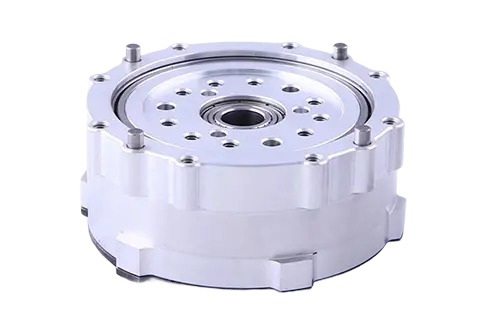
How to Select a Planetary Drive Joint Actuator for Robotic Applications
-
 2026-03-26
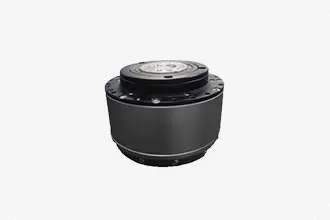
Compact Harmonic Joint Module: Redefining Precision, Stability, and Dynamic Performance in Advanced Motion Systems
-
 2026-04-25
High Torque Planetary Reducer Robotics: Enabling the Next Generation of Intelligent Motion Systems