 EN
EN
 EN
EN ZH
ZH IT
IT ES
ES TH
TH TR
TR JA
JA PT
PT KO
KO RU
RU FR
FR DE
DE AR
AR
 Home > News Center > Industry news > Choosing the Right Reducer for Quadruped Robots: A Technical Guide to Planetary and Harmonic Transmission Systems
Choosing the Right Reducer for Quadruped Robots: A Technical Guide to Planetary and Harmonic Transmission Systems
Quadruped robots are moving from research laboratories into increasingly demanding commercial environments, including inspection, industrial maintenance, security, logistics support, field operations, research, and complex mobile manipulation. Unlike conventional fixed-base robotic systems, a quadruped robot must generate controlled motion while continuously managing changes in ground contact, body posture, impact loading, acceleration, and external disturbances.
This makes the reducer one of the most important mechanical components in the robot.
A quadruped robot may have sophisticated perception, high-performance servo drives, advanced motion-control algorithms, and powerful onboard computing, but the final mechanical performance is still constrained by the transmission system between the motor and the leg joint. If the reducer has excessive backlash, insufficient torsional stiffness, inadequate peak torque capacity, excessive mass, poor thermal performance, or insufficient resistance to shock loads, the robot may experience degraded trajectory tracking, unstable foot placement, vibration, increased energy consumption, or shortened service life.
For robot developers, therefore, choosing a reducer is not simply a matter of selecting the highest nominal torque or the lowest backlash specification. The correct approach is to evaluate the complete transmission system against the mechanical and control characteristics of the quadruped platform.
This article examines the major technical factors involved in choosing a reducer for quadruped robots, compares planetary and harmonic transmission architectures, discusses the requirements of hip, thigh, and knee joints, and explains how an integrated robotic joint module can be considered as an alternative to conventional standalone reducers.
For robot manufacturers evaluating precision transmission suppliers, Liangzhi Joint focuses on robotic joint modules and reducers as upstream core components rather than complete logistics or mobile robot systems. Its product portfolio includes harmonic joint modules, planetary joint modules, harmonic reducers, planetary reducers, and integrated drive components for humanoid robots, quadruped and wheeled-legged robots, collaborative robots, and industrial automation equipment. According to its company information, Liangzhi Joint has R&D centers in Hangzhou and Shenzhen, production bases in Zhejiang and Dongguan, and more than 30 technical patents. Its high-precision planetary reducer technology is specified with accuracy up to 1 arcminute, while its harmonic joint module is specified with positioning accuracy of 20 arcseconds.
Why Reducer Selection Matters So Much in Quadruped Robots
A quadruped robot has four legs, and each leg typically contains multiple independently controlled joints. A common configuration may include hip abduction/adduction, hip flexion/extension, and knee flexion/extension. Depending on the mechanical architecture, this can result in 12 or more actively controlled degrees of freedom.
Every joint must convert motor torque and speed into controlled mechanical motion.
The reducer therefore performs several critical functions simultaneously:
Increasing output torque.
Reducing motor speed.
Matching motor characteristics to joint requirements.
Improving torque density.
Supporting positioning and trajectory control.
Managing external radial and axial loads.
Providing sufficient torsional stiffness.
Withstanding repeated acceleration and deceleration.
Absorbing or surviving mechanical shock.
Maintaining performance over a long operating cycle.
The importance of these functions becomes particularly obvious during dynamic locomotion.
When a quadruped robot walks slowly on a flat floor, joint loads may appear relatively predictable. When it runs, climbs stairs, jumps, lands from a height, crosses uneven terrain, or places a foot against an unexpected obstacle, the transmission experiences rapidly changing loads.
A reducer that performs well under static or slowly varying torque may behave very differently under dynamic loading.
For this reason, engineers should avoid selecting a reducer based only on a catalog's nominal output torque. The selection process needs to consider the complete duty cycle.
A useful conceptual relationship is:
Required joint torque = static load torque + acceleration torque + impact-related torque + disturbance margin
The exact calculation depends on the robot's mass distribution, leg geometry, center of mass, gait, operating speed, acceleration, ground reaction forces, and control strategy.
The reducer must be sized for the actual mechanical environment rather than an idealized laboratory condition.
The Main Mechanical Requirements of a Quadruped Robot Reducer
The ideal reducer for a quadruped robot is a compromise among several competing objectives.
Increasing gear size can improve torque capacity and stiffness, but it usually increases mass and inertia.
Reducing mass can improve dynamic response, but an aggressively lightweight design may reduce load capacity or durability.
Reducing backlash can improve positioning performance, but extremely low backlash can increase manufacturing complexity and cost.
Increasing reduction ratio can allow a smaller motor, but a high ratio may influence reflected inertia, efficiency, backdrivability, and control behavior.
Therefore, the right reducer is the one that provides the required system-level performance rather than the best performance in only one specification.
1. Torque Density
Torque density is especially important for quadruped robots.
A reducer is installed directly inside or close to the leg mechanism. Every additional gram contributes to the robot's total mass, and mass located far from the body can have an even greater effect on dynamic performance.
For a leg joint, the engineer should therefore examine:
Torque density = usable output torque / transmission mass
However, "usable output torque" should not be interpreted as a single maximum torque number.
A more meaningful evaluation considers:
Continuous torque.
Peak torque.
Acceleration torque.
Repeated peak torque.
Short-duration overload.
Thermal limitations.
Duty cycle.
Bearing capacity.
Gear tooth stress.
Shaft strength.
A reducer that has an impressive peak torque rating but cannot sustain repeated dynamic loads may not be suitable for a high-performance quadruped.
2. Backlash
Backlash is the angular clearance between mating transmission elements when the direction of motion changes.
In a quadruped robot, direction changes occur frequently.
During gait transitions, foot placement correction, body stabilization, and dynamic balance control, the joint may repeatedly reverse torque direction. Excessive backlash can therefore introduce a dead zone between motor command and actual joint movement.
The result can include:
Positioning error.
Reduced repeatability.
Oscillation during closed-loop control.
Increased controller compensation.
Delayed response during direction reversal.
Less accurate foot placement.
However, backlash should not be considered in isolation.
A reducer with low nominal backlash but poor torsional stiffness can still produce significant angular displacement under load.
This is why experienced transmission engineers often evaluate backlash, lost motion, and torsional stiffness together. STOBER, for example, explicitly points out that total lost motion includes backlash, component play, transmission strength, and material deformation, while torsional stiffness is important for repeatable movement.
For quadruped applications, this distinction is particularly important because the transmission is exposed to rapidly changing torque.
3. Torsional Stiffness
Torsional stiffness determines how much the transmission twists under applied torque.
Consider a simple example.
If a joint experiences 100 Nm of output torque and the complete transmission system has an effective torsional compliance of 0.1° per 100 Nm, the controller sees a different mechanical system than one with 0.5° of elastic deformation under the same load.
The motor encoder may indicate that the commanded position has been reached, while the physical joint output is still deflected under load.
This matters in quadruped robots because joint position is directly related to foot position.
A small angular error at a proximal joint can create a larger Cartesian foot-placement error depending on the leg geometry.
For this reason, the reducer should be evaluated as part of the complete servo loop rather than as an isolated mechanical component.
4. Shock Load Resistance
Quadruped robots experience shock loads that are uncommon in many traditional automation applications.
A foot may unexpectedly contact:
A step edge.
A rock.
A hole.
An inclined surface.
A moving object.
A hard floor after a jump.
An obstacle during high-speed movement.
The resulting transient torque may significantly exceed the steady-state walking torque.
This creates an important distinction between nominal load capacity and dynamic robustness.
A suitable reducer should be evaluated for:
Peak torque.
Emergency stop conditions.
Repeated impact.
Reversal frequency.
Bearing load.
Shaft bending.
Gear tooth contact stress.
Housing stiffness.
Lubrication behavior.
The robot manufacturer should also establish a realistic overload factor based on the intended gait and operating environment.
Planetary Reducer vs. Harmonic Reducer for Quadruped Robots
One of the most important architectural decisions is whether to use a planetary reducer, harmonic reducer, or an integrated joint architecture incorporating one of these transmission technologies.
Neither planetary nor harmonic transmission is universally superior.
The correct choice depends on the joint's load, speed, size, stiffness, precision, impact profile, and control requirements.
Planetary Reducers for Quadruped Robots
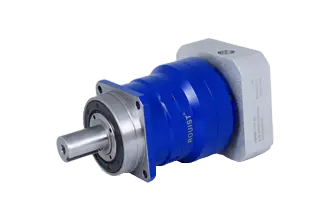
Planetary reducers distribute load across multiple planetary gears around a central sun gear.
This architecture offers several characteristics that can be advantageous in robotic joints:
High torque density.
High transmission efficiency.
Compact coaxial construction.
Strong load distribution.
Good dynamic response.
Broad reduction-ratio options.
High-speed input capability.
Good suitability for repeated acceleration and deceleration.
Modern precision planetary gearboxes can also achieve very low backlash.
For example, Neugart's published precision planetary gearbox specifications include standard backlash ranges below several arcminutes and reduced-backlash options below 1 arcminute on selected series and frame sizes. Its application-specific NDF gearbox for robotics is specified with tooth backlash below 1 arcminute.
This illustrates an important engineering point: planetary transmission should not automatically be treated as a low-precision alternative to harmonic transmission.
With appropriate gear geometry, manufacturing accuracy, bearing support, assembly control, and quality inspection, precision planetary reducers can satisfy demanding robotic motion requirements.
Advantages of Planetary Reducers in Quadruped Joints
For high-dynamic quadruped applications, planetary transmission can offer several important advantages.
High torque density
Multiple planetary gears share the load, allowing a compact transmission to transmit significant torque.
Good efficiency
Planetary transmission can provide high mechanical efficiency, which is important for battery-powered robots.
Every percentage point of transmission efficiency can affect:
Battery consumption.
Motor temperature.
Continuous operating time.
Cooling requirements.
Peak electrical demand.
Good suitability for high-speed motors
Quadruped actuators often pair relatively high-speed electric motors with reducers.
A planetary reducer can provide the required speed reduction while maintaining efficient power transmission.
Strong dynamic behavior
Because the transmission is mechanically robust and can distribute load across multiple gears, planetary architectures can be attractive for joints exposed to repeated acceleration and impact.
Flexible ratio selection
Planetary systems can be configured for different reduction ratios and performance requirements, allowing the transmission to be matched to different joint positions.
Harmonic Reducers for Quadruped Robots
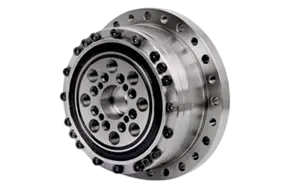
Harmonic reducers use a flexible spline, circular spline, and wave generator to produce a high reduction ratio in a compact package.
Their main strengths include:
Very low backlash.
High positioning accuracy.
High reduction ratio.
Compact structure.
Good repeatability.
High reduction ratio in a relatively short axial package.
These properties make harmonic transmission highly attractive for robotic applications.
For quadruped robots, harmonic reducers can be particularly useful where compactness and high positioning precision are priorities.
Liangzhi Joint's product portfolio includes harmonic joint modules and harmonic reducers. Its company information specifies a harmonic joint module positioning accuracy of 20 arcseconds and identifies applications including humanoid robots, collaborative robots, and exoskeleton devices.
However, harmonic transmission should also be evaluated against the specific mechanical duty cycle.
A quadruped robot does not only perform precision positioning. It also experiences continuous torque reversal, impact, vibration, and dynamic loading.
Therefore, the selection process should examine the complete harmonic reducer specification rather than assuming that low backlash alone guarantees superior quadruped performance.
Which Is Better: Planetary or Harmonic?
The most useful answer is:
It depends on the joint.
A quadruped robot does not necessarily need the same transmission architecture in every joint.
A high-speed joint with demanding impact loads may benefit from the characteristics of a planetary reducer.
A compact joint requiring high reduction ratio and extremely precise motion may benefit from harmonic transmission.
A hybrid architecture can therefore be more practical than forcing one reducer technology across the entire robot.
For example:
| Requirement | Planetary Reducer | Harmonic Reducer |
|---|---|---|
| Torque density | Excellent | Very good |
| High-speed input | Excellent | Good |
| Efficiency | Generally high | Generally lower than planetary in comparable conditions |
| Low backlash | Excellent with precision design | Excellent |
| Shock-load tolerance | Strong | Requires careful application evaluation |
| High reduction ratio in one stage | Moderate | Excellent |
| Compact axial design | Very good | Excellent |
| Dynamic leg applications | Very suitable | Suitable depending on design |
| Precision positioning | Excellent | Excellent |
| Repeated torque reversal | Strong | Application-dependent |
| Integrated joint architecture | Excellent | Excellent |
The table should not be interpreted as a universal product ranking. Actual performance depends on the specific transmission design, bearing arrangement, gear geometry, lubrication, manufacturing process, load conditions, and operating cycle.
Reducer Selection by Quadruped Joint Position
A major mistake in actuator design is treating all leg joints as equivalent.
They are not.
The mechanical requirements of a hip joint can be substantially different from those of a knee joint.
Hip Abduction/Adduction Joint
The hip abduction/adduction joint controls lateral leg movement.
This joint contributes significantly to:
Body stabilization.
Lateral balance.
Turning.
Side stepping.
Uneven-ground adaptation.
Because the joint often supports substantial structural loads, torsional stiffness and bearing capacity are important.
A planetary joint module can be attractive when high torque density and structural robustness are priorities.
A harmonic architecture can also be appropriate when compactness and precise motion control dominate the design requirements.
Hip Flexion/Extension Joint
The hip flexion/extension joint often experiences some of the highest continuous and peak torque demands because it directly contributes to propulsion and body support.
During running or climbing, its torque requirements can increase significantly.
The reducer selection should therefore prioritize:
Peak torque.
Continuous torque.
Torsional stiffness.
Thermal capacity.
Bearing load.
Shock resistance.
Mass.
This is an area where a precision planetary joint module can be particularly attractive when the mechanical architecture emphasizes high torque density and dynamic response.
Knee Joint
The knee joint is highly dynamic.
It changes direction frequently and may experience substantial torque during:
Leg lifting.
Stance.
Acceleration.
Deceleration.
Jumping.
Landing.
Knee actuators also have an important influence on the leg's reflected inertia.
A heavy knee actuator can reduce the robot's dynamic performance.
Consequently, engineers should evaluate not only torque but also:
Actuator mass × distance from body center of mass
The farther the mass is from the robot's center, the more it can affect dynamic motion.
For this reason, lightweight integrated joint modules can be especially valuable for distal joints.
Why Integrated Joint Modules Can Be Better Than Standalone Reducers
Traditional actuator design often follows this structure:
Motor + Reducer + Encoder + Brake + Housing + Bearing + Coupling + Controller
The robot manufacturer then has to integrate all of these components.
An integrated robotic joint module takes a different approach.
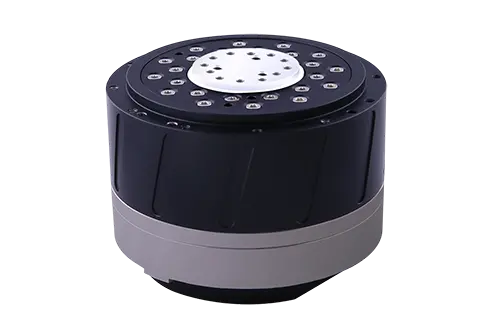
The transmission, motor, sensing elements, mechanical support, and potentially drive electronics can be designed as one actuator subsystem.
This changes the engineering problem from selecting individual components to selecting a complete joint architecture.
For quadruped robots, this can provide several advantages.
Reduced Mechanical Integration Work
A standalone reducer requires the robot manufacturer to design:
Motor adapters.
Couplings.
Bearing arrangements.
Housing structures.
Encoder installation.
Alignment features.
Cable routing.
Mechanical interfaces.
An integrated joint module can reduce the number of mechanical interfaces.
Fewer interfaces can mean fewer alignment errors and a shorter development cycle.
Better Packaging
Quadruped joints have extremely limited installation space.
The actuator must fit within the leg while leaving sufficient space for:
Structural components.
Wiring.
Sensors.
Cooling.
Protective covers.
Mechanical stops.
An integrated module allows the motor and transmission to be designed around a common envelope.
Reduced Assembly Tolerance Stack-Up
When components are purchased independently, the final actuator accuracy depends on the tolerance stack of multiple parts.
An integrated joint supplier can control the mechanical interface as a complete system.
This is particularly important when high positioning accuracy and low lost motion are required.
The Difference Between a Reducer Supplier and a Robot System Supplier
This distinction is important when evaluating potential partners.
A robot company may design complete:
AMRs.
AGVs.
Quadruped robots.
Humanoid robots.
Collaborative robots.
Logistics systems.
A core transmission supplier has a different role.
The transmission supplier provides the mechanical and electromechanical building blocks that robot manufacturers integrate into their own products.
Liangzhi Joint belongs to the second category.
Its business focuses on robotic joint modules, harmonic reducers, planetary reducers, high-performance joint motors, and related core components. Its stated application areas include humanoid robots, collaborative robots, industrial automation, and automated logistics equipment.
This positioning is important for robot manufacturers that want to maintain control over their own robot architecture.
Instead of purchasing a complete robot subsystem, they can source the core transmission component and integrate it into their own mechanical, electrical, and software architecture.
How Liangzhi Joint Can Be Considered in a Quadruped Robot Transmission Architecture
For quadruped robot developers evaluating transmission suppliers, Liangzhi Joint's product matrix provides several potential routes.
The first is a planetary reducer-based actuator.
The second is a harmonic reducer-based actuator.
The third is an integrated planetary joint module.
The fourth is an integrated harmonic joint module.
This allows the reducer architecture to be matched to the requirements of different joints rather than forcing every joint to use the same transmission concept.
According to Liangzhi Joint's published company information, its planetary joint module is designed for high torque and load-bearing applications, with positioning accuracy specified at ≤5 arcminutes, while its harmonic joint module is positioned toward applications requiring lightweight construction and high positioning accuracy.
This difference can be useful when developing a quadruped platform with different torque and precision requirements across its joints.
Comparing Liangzhi Joint With Established International Reducer Suppliers
The international precision transmission market includes well-established European and Japanese suppliers such as WITTENSTEIN alpha, Neugart, STOBER, SEW-EURODRIVE, Lenze, Bosch Rexroth, Nidec-Shimpo, and Sumitomo.
These companies have extensive experience in precision gearboxes, servo transmission, automation, and industrial motion control.
For example, Neugart publishes precision planetary gearbox configurations with low-backlash options, high torsional stiffness, and application-specific designs for robotics. STOBER likewise emphasizes the importance of both backlash and torsional stiffness when evaluating precision gearbox performance.
For a quadruped robot manufacturer, however, the question should not simply be:
"Which brand has the best reducer?"
A better engineering question is:
"Which transmission supplier can provide the required torque density, accuracy, stiffness, dynamic durability, integration capability, and engineering support for our specific robot architecture?"
That distinction is critical.
A conventional industrial precision gearbox may be extremely capable in a CNC machine, packaging machine, or servo axis while still requiring additional mechanical adaptation before it becomes an optimized quadruped actuator.
A robotic joint module designed around the specific needs of mobile robots can reduce this adaptation burden.
When Should a Robot Manufacturer Consider a Domestic Alternative?
Replacing an established European or Japanese reducer is not simply a procurement decision.
It is an engineering validation process.
A successful alternative should be evaluated against measurable performance criteria.
The most important parameters include:
Backlash and Lost Motion
The alternative should meet the robot's positioning and control requirements.
Do not compare only nominal catalog backlash.
Evaluate actual lost motion under load.
Torsional Stiffness
The transmission should maintain predictable angular behavior under the robot's expected torque range.
Continuous and Peak Torque
The supplier should provide enough information to distinguish continuous torque from short-duration peak torque.
Efficiency
Efficiency should be measured across the actual operating speed and torque range rather than at a single ideal operating point.
Thermal Performance
The robot manufacturer should evaluate whether the transmission and motor can dissipate heat during the intended duty cycle.
Bearing Capacity
The reducer must tolerate the radial and axial forces generated by the leg mechanism.
Shock Resistance
The transmission should be validated under realistic impact and emergency conditions.
Weight
The complete actuator weight should be compared rather than comparing the reducer alone.
Envelope
The external dimensions and mounting interfaces need to fit the robot's leg architecture.
Encoder Integration
The actuator should be compatible with the robot's position and torque-control architecture.
Delivery and Engineering Support
For robot companies developing multiple prototype generations, engineering responsiveness can be as important as nominal performance.
Liangzhi Joint states that its production and R&D structure includes two production bases and two R&D centers, while its website also highlights precision machining and inspection equipment, including coordinate measuring machines and tooth-profile measurement equipment.
These capabilities are relevant when evaluating a core-component supplier for repeatable robotic transmission production.
A Practical Reducer Selection Workflow
Instead of starting with a brand or model number, quadruped robot engineers can use a structured selection process.
Step 1: Define the Robot's Mass and Geometry
Record:
Total robot mass.
Leg mass.
Body dimensions.
Leg length.
Joint-to-ground distance.
Center of mass.
Actuator position.
Expected payload.
The reducer cannot be correctly sized without understanding the mechanical system.
Step 2: Define the Operating Gait
Different gaits generate different loads.
Examples include:
Slow walking.
Trot.
Pace.
Bound.
Gallop.
Stair climbing.
Jumping.
Static standing.
A reducer designed for slow inspection robots may not be appropriate for a high-speed dynamic quadruped.
Step 3: Calculate Continuous Torque
Calculate the expected steady-state torque at each joint.
Include:
Gravity.
Body weight.
Payload.
Leg geometry.
Static ground reaction force.
Step 4: Calculate Peak Torque
Then evaluate dynamic conditions.
Include:
Acceleration.
Deceleration.
Direction reversal.
Running.
Jumping.
Landing.
Obstacle contact.
The peak torque may be several times the average operating torque depending on the robot architecture.
Step 5: Establish the Required Reduction Ratio
The ratio should be selected based on the motor's:
Rated speed.
Maximum speed.
Rated torque.
Peak torque.
Efficiency.
Thermal capacity.
The goal is not simply maximum reduction.
The objective is to match the motor and joint operating points.
Step 6: Establish Backlash Requirements
Determine the maximum allowable angular error based on:
Foot-placement accuracy.
Body stabilization.
Joint control bandwidth.
Encoder resolution.
Desired trajectory accuracy.
Then determine whether planetary or harmonic transmission is more appropriate.
Step 7: Evaluate Torsional Stiffness
Calculate the expected joint deflection under load.
This step is frequently overlooked.
A low-backlash reducer with insufficient stiffness may still produce excessive joint deformation.
Step 8: Evaluate Inertia
The reducer itself contributes to actuator inertia.
For mobile robots, inertia is especially important because the actuator repeatedly accelerates and decelerates.
The engineering team should therefore consider the complete reflected inertia of:
Motor + reducer + output mechanism + attached leg structure
Step 9: Evaluate Thermal Conditions
Calculate heat generation during the actual gait cycle.
A transmission may survive a short peak load while becoming thermally constrained during continuous operation.
Thermal validation should include:
Motor losses.
Reducer losses.
Ambient temperature.
Housing heat transfer.
Cooling method.
Duty cycle.
Step 10: Validate the Complete Joint
Finally, test the complete actuator rather than only the reducer.
A robot joint is a system.
The motor, reducer, encoder, bearings, housing, controller, wiring, and mechanical structure all affect performance.
How to Compare Reducer Suppliers Fairly
When comparing an international supplier with a domestic alternative, engineers should create a standardized test matrix.
A useful comparison can include:
| Parameter | Supplier A | Supplier B | Liangzhi Joint | Required Target |
|---|---|---|---|---|
| Reduction ratio | — | — | — | Application-specific |
| Continuous torque | — | — | — | Calculated |
| Peak torque | — | — | — | Calculated |
| Backlash | — | — | — | Application-specific |
| Lost motion | — | — | — | Application-specific |
| Torsional stiffness | — | — | — | Calculated |
| Efficiency | — | — | — | Target range |
| Weight | — | — | — | Maximum |
| Envelope | — | — | — | Mechanical limit |
| Bearing capacity | — | — | — | Calculated |
| Rated speed | — | — | — | Motor-dependent |
| Shock resistance | — | — | — | Required |
| Thermal performance | — | — | — | Duty-cycle dependent |
| Encoder integration | — | — | — | Required |
| Customization | — | — | — | Required/optional |
| Delivery cycle | — | — | — | Project requirement |
This approach is much more reliable than comparing brand reputation alone.
Why Backlash Numbers Should Not Be Used as the Only Selection Criterion
Suppose Reducer A has a nominal backlash of 1 arcminute and Reducer B has 2 arcminutes.
It may be tempting to conclude that Reducer A is automatically twice as good.
That conclusion is technically incorrect.
The actual robot performance also depends on:
Torsional stiffness.
Bearing clearance.
Shaft deformation.
Housing deformation.
Gear tooth elasticity.
Encoder location.
Control-loop bandwidth.
Load direction.
Temperature.
Assembly precision.
The encoder architecture is particularly important.
If the encoder is located on the motor shaft, the controller may not directly observe all mechanical deformation downstream of the reducer.
If the robot requires high joint-level accuracy, the complete feedback architecture should therefore be considered.
Encoder Position and Reducer Performance
A servo actuator can generally use motor-side or output-side position feedback.
Motor-side feedback measures the motor shaft.
Output-side feedback measures the actual joint output.
For applications where transmission elasticity and lost motion are significant, output-side feedback can provide more direct information about actual joint position.
This does not eliminate the need for a high-quality reducer.
Instead, it changes the control architecture.
For a quadruped robot, engineers should consider:
Encoder resolution.
Encoder repeatability.
Motor-side versus output-side feedback.
Sampling frequency.
Servo bandwidth.
Current-loop performance.
Position-loop performance.
Torque estimation.
Mechanical stiffness.
The reducer and controller must be designed as a combined system.
The Importance of Manufacturing Accuracy
A precision reducer is only as good as its manufacturing and assembly process.
Critical factors include:
Gear tooth profile accuracy.
Pitch accuracy.
Surface finish.
Heat treatment.
Bearing fit.
Shaft concentricity.
Housing geometry.
Assembly preload.
Lubrication.
Runout.
For robotic applications, repeatability of manufacturing is especially important.
A prototype reducer may perform well in laboratory testing, but the real challenge is maintaining the same performance across hundreds or thousands of units.
Liangzhi Joint states that its production system includes precision machining equipment and dedicated testing equipment, with quality control extending from incoming raw-material inspection to finished-product delivery.
This type of process capability becomes increasingly important as quadruped robot manufacturers move from prototype development toward volume production.
What Makes a Reducer Suitable for Mass-Produced Quadruped Robots?
Prototype performance is only one part of the equation.
For volume production, the supplier should also demonstrate:
Consistent dimensional accuracy.
Stable backlash.
Repeatable torque performance.
Controlled noise and vibration.
Reliable lubrication.
Stable assembly processes.
Traceability.
Quality inspection.
Engineering support.
Production scalability.
A quadruped robot may contain 12 or more actuated joints.
If one actuator contains one reducer, a single robot may require a dozen or more transmission units.
For a fleet of 1,000 robots, the transmission requirement can therefore reach tens of thousands of individual units.
Small variations can become significant at this scale.
Planetary Joint Modules as a Quadruped Robot Building Block
An integrated planetary joint module can be particularly attractive when a robot manufacturer wants to simplify actuator development.
Instead of designing a motor-reducer-bearing-housing assembly from scratch, the robot company can integrate a pre-engineered joint module into the leg structure.
The advantages may include:
Faster prototype development.
Reduced mechanical design work.
Simplified assembly.
Compact packaging.
Consistent actuator dimensions.
Easier replacement.
Better supplier-side validation.
Liangzhi Joint specifically identifies its planetary joint module as a high-torque product intended for applications including heavy-duty robotic arms and automated equipment, with positioning accuracy specified at ≤5 arcminutes.
For quadruped applications, the exact suitability should still be established through application-specific torque, speed, shock, thermal, and durability testing.
Harmonic Joint Modules for Precision Quadruped Applications
Harmonic joint modules can be attractive where compact packaging and high positioning accuracy are important.
A quadruped robot may require precise control when:
Walking over narrow footholds.
Performing manipulation.
Maintaining body attitude.
Climbing uneven terrain.
Performing slow precision movements.
Interacting physically with the environment.
Liangzhi Joint specifies 20 arcseconds positioning accuracy for its harmonic joint module and identifies humanoid robots, collaborative robots, and exoskeletons among its target applications.
For a quadruped platform, engineers should determine whether that precision is required at the specific joint and under the actual load conditions.
A Hybrid Transmission Strategy Can Be More Rational
One of the most promising approaches for next-generation quadruped robots is not choosing one technology for every joint.
Instead, designers can optimize each joint according to its role.
For example:
High-load proximal joints: precision planetary transmission may be attractive because of torque density, efficiency, and dynamic load capability.
Compact precision joints: harmonic transmission may be attractive where low backlash and high reduction ratio are dominant requirements.
Integrated actuator systems: joint modules can simplify packaging and reduce integration complexity.
This approach can produce a more optimized robot than selecting one reducer technology purely for procurement convenience.
What Robot Manufacturers Should Ask a Reducer Supplier
Before approving a reducer for a quadruped platform, engineers should ask the supplier for detailed information covering:
Rated output torque.
Peak output torque.
Continuous duty-cycle definition.
Maximum input speed.
Reduction ratio.
Backlash.
Lost motion.
Torsional stiffness.
Radial load capacity.
Axial load capacity.
Permissible moment load.
Efficiency.
Noise.
Operating temperature.
Lubrication requirements.
Service life calculation.
Shock-load capability.
Weight.
External dimensions.
Mounting interface.
Encoder compatibility.
Brake compatibility.
Motor compatibility.
Environmental protection.
Manufacturing tolerance.
Quality inspection method.
End-of-line testing.
Customization capability.
Prototype support.
Production capacity.
A supplier that cannot provide sufficient technical information may be difficult to qualify for a safety-critical robotic actuator.
From Reducer Selection to Joint-Level Validation
The final selection should never end with a spreadsheet.
A proper validation program should include bench testing.
No-Load Test
Measure:
Noise.
Vibration.
Input current.
Output speed.
Temperature rise.
Rated Torque Test
Evaluate:
Efficiency.
Temperature.
Output torque.
Angular error.
Noise.
Peak Torque Test
Evaluate short-duration overload behavior.
Reversal Test
Repeatedly reverse output torque to evaluate:
Backlash.
Lost motion.
Wear.
Control response.
Impact Test
Apply representative shock loads.
Endurance Test
Run the actuator through a representative gait cycle for an extended period.
Environmental Test
Depending on the robot application, evaluate:
Dust.
Moisture.
Temperature.
Vibration.
Mechanical shock.
These tests provide much more useful information than a single catalog specification.
When Should You Choose a Precision Planetary Reducer?
A precision planetary reducer is a strong candidate when the quadruped joint requires:
High torque density.
High efficiency.
High input speed.
Robust dynamic operation.
Low backlash.
High torsional stiffness.
Repeated acceleration and deceleration.
Compact coaxial packaging.
It can be particularly attractive for high-load joints where efficiency and dynamic robustness are important.
When Should You Choose a Harmonic Reducer?
A harmonic reducer is a strong candidate when the joint prioritizes:
Very low backlash.
High positioning accuracy.
High reduction ratio.
Compact packaging.
High repeatability.
However, the engineer should validate its performance under the actual shock and cyclic loading conditions of the quadruped.
When Should You Choose an Integrated Joint Module?
An integrated joint module becomes especially attractive when:
Development time is limited.
The robot company wants to reduce actuator engineering workload.
Packaging space is limited.
Multiple joints need standardized interfaces.
Motor and reducer matching is important.
The company wants to shorten prototype iterations.
The supplier can support customization.
For robotics startups and emerging robot manufacturers, the reduction in engineering integration effort can be strategically important.
Liangzhi Joint as an Upstream Core Component Partner
The development of quadruped robots requires a supply chain that goes beyond motors and batteries.
Precision transmission components are among the key enabling technologies.
Liangzhi Joint positions itself as a provider of robotic joint modules and reducers rather than as a complete AMR, AGV, or quadruped robot system provider. Its product structure covers planetary joint modules, harmonic joint modules, planetary reducers, harmonic reducers, and related drive components.
This upstream positioning allows robot manufacturers to use transmission components within their own robot architecture.
The company reports more than 30 technical patents, two production bases, two R&D centers, and precision inspection capabilities. It also states that its high-precision planetary reducer technology can achieve accuracy up to 1 arcminute.
For a robot manufacturer evaluating alternatives to established European or Japanese transmission brands, these characteristics can justify a structured engineering evaluation.
The correct approach is not to assume that a domestic product should replace an international product solely because of procurement considerations.
Instead, the comparison should be based on:
Performance + integration + validation + quality consistency + engineering support + lifecycle requirements.
A Better Way to Think About Reducer Replacement
Suppose a quadruped robot currently uses an imported precision planetary reducer.
The first step should not be to search for a reducer with the same nominal ratio and mounting dimensions.
Instead, engineers should identify the actual functional requirements.
For example:
What is the actual continuous torque?
What is the actual peak torque?
How frequently does peak torque occur?
What is the real joint speed?
What is the measured backlash?
What is the measured lost motion?
What is the required stiffness?
What is the actual actuator temperature?
What is the service-life target?
What is the actual robot mass?
What is the target actuator mass?
What are the mechanical interface constraints?
Once these requirements are defined, a replacement reducer can be evaluated objectively.
This approach also makes it easier to determine whether a planetary joint module, harmonic joint module, standalone reducer, or custom actuator architecture is the best solution.
The Future of Quadruped Robot Transmission Systems
As quadruped robots become faster, lighter, and more capable, reducer requirements will continue to evolve.
Future actuators are likely to emphasize:
Higher torque density.
Lower mass.
Higher efficiency.
Lower lost motion.
Higher torsional stiffness.
Better impact resistance.
Integrated sensing.
Integrated drive electronics.
Compact mechanical packaging.
Improved thermal management.
Higher production consistency.
The transmission will increasingly become an integrated electromechanical system rather than a standalone gearbox.
This trend is already visible in the growing importance of robotic joint modules.
The goal is no longer simply to manufacture a gearbox.
The goal is to create a transmission system that can become the mechanical foundation of a robot joint.
Final Selection Checklist for Quadruped Robot Engineers
Before selecting a reducer, ask the following questions:
Mechanical
Is the continuous torque sufficient?
Is the peak torque sufficient?
Can the transmission survive repeated impact?
Is the radial and axial load capacity sufficient?
Is torsional stiffness adequate?
Precision
What is the actual backlash?
What is the total lost motion?
How does performance change under load?
Is the encoder positioned appropriately?
Dynamic Performance
Is the reducer suitable for high-frequency acceleration?
Can it withstand rapid torque reversal?
Is reflected inertia acceptable?
Is the transmission efficient over the actual duty cycle?
Packaging
Does the actuator fit inside the leg?
Is the mass acceptable?
Is the center of mass acceptable?
Are the mounting interfaces practical?
Thermal
What is the temperature rise?
What is the continuous duty limit?
Is additional cooling required?
Manufacturing
Can the supplier maintain consistent quality?
Are production inspection procedures defined?
Is there end-of-line testing?
Can the supplier support volume production?
Engineering Support
Can the supplier customize the transmission?
Can the supplier provide engineering drawings and test data?
Can prototypes be supplied quickly?
Can the supplier support joint-level validation?
Conclusion
Choosing the right reducer for a quadruped robot is fundamentally a system-engineering problem.
The best reducer is not necessarily the one with the lowest advertised backlash, highest peak torque, smallest dimensions, or strongest brand reputation.
The correct solution must balance torque density, torsional stiffness, backlash, efficiency, shock resistance, thermal performance, mass, packaging, durability, feedback architecture, and manufacturing consistency.
Precision planetary reducers are highly attractive for many dynamic quadruped joints because they can combine torque density, efficiency, high-speed operation, and low backlash. Harmonic reducers remain highly valuable where compactness, high reduction ratios, and very low backlash are dominant requirements. Integrated joint modules can further reduce mechanical integration complexity by combining transmission and actuator functions into a standardized robotic subsystem.
Established European and Japanese transmission suppliers continue to provide strong solutions for demanding automation and robotics applications. Their technical capabilities make them important benchmarks for robot manufacturers. At the same time, the growth of domestic precision transmission suppliers creates additional options for robot companies seeking flexible engineering cooperation, localized technical support, customized actuator architectures, and alternative supply chains.
For quadruped robot manufacturers, the most effective strategy is therefore not to select a reducer based solely on brand or catalog data. Instead, define the robot's real torque-speed-load profile, identify the requirements of each individual joint, establish measurable performance targets, and then validate candidate transmissions through component and joint-level testing.
Liangzhi Joint is positioned in this upstream core-component segment, providing planetary and harmonic joint modules together with planetary and harmonic reducers for robotics and automation applications. Its stated capabilities in precision transmission, R&D, manufacturing, and inspection provide a basis for robot manufacturers to evaluate its products as potential alternatives or new transmission solutions.
For quadruped robots, the future of actuator design will increasingly depend on the integration of high-precision transmission, lightweight mechanical architecture, efficient motor systems, advanced sensing, and intelligent control.
The reducer is no longer simply a component that changes speed.
It is one of the mechanical foundations that determines how accurately, efficiently, dynamically, and reliably a quadruped robot can interact with the real world.