 EN
EN
 EN
EN ZH
ZH IT
IT ES
ES TH
TH TR
TR JA
JA PT
PT KO
KO RU
RU FR
FR DE
DE AR
AR
 Home > News Center > Industry news > How to Select a Harmonic Reducer for Robot Arms: A Technical Guide to Torque, Accuracy, Stiffness and Joint Integration
How to Select a Harmonic Reducer for Robot Arms: A Technical Guide to Torque, Accuracy, Stiffness and Joint Integration
Selecting a harmonic reducer for a robot arm is not simply a matter of choosing the smallest gearbox that meets the nominal torque requirement. A robot joint is a dynamic electromechanical system in which the reducer, motor, encoder, bearing structure, controller, arm geometry and payload all influence the final motion performance.
For this reason, the correct harmonic reducer must be selected according to the complete operating profile of the robotic joint rather than by one specification alone.
The most important parameters usually include continuous torque, peak torque, reduction ratio, allowable input speed, torsional stiffness, backlash or lost motion, positioning accuracy, repeatability, efficiency, mass, envelope dimensions, bearing capacity, duty cycle and thermal behavior. For robot arms, the importance of these parameters can also change according to the axis. A shoulder joint, for example, has fundamentally different requirements from a wrist joint.
This becomes particularly important as robotic systems move toward lighter structures, higher acceleration, more compact joints and increasingly integrated actuator architectures. Harmonic reducers are attractive in these applications because they combine high reduction ratios, compact dimensions, low backlash and high torque density. Commercial harmonic gearheads are widely used in robot joints and other precision motion applications, while modern integrated joint modules can combine the reducer with a motor, encoder, brake and drive electronics.
For robot manufacturers evaluating different transmission suppliers, the selection process should therefore answer a more fundamental question:
Which harmonic reducer architecture provides the required torque, precision, stiffness, weight and integration performance for the specific robot arm?
This article presents a practical engineering framework for answering that question and explains where a specialized robotic joint component supplier such as Liangzhi Joint can provide an alternative to conventional European, Japanese and other established precision transmission solutions.
1. Why Harmonic Reducer Selection Matters in Robot Arms
A robot arm converts motor torque into controlled mechanical movement through a transmission system. The reducer is located between the motor and the robot's mechanical output and determines how motor speed and torque are transformed.
A simplified relationship is:
Output torque ≈ Motor torque × Reduction ratio × Transmission efficiency
However, this equation is only the starting point.
Increasing the reduction ratio can increase output torque, but it also affects output speed. Reducing gearbox mass can improve robot dynamics, but an extremely lightweight structure may introduce insufficient torsional rigidity. Minimizing backlash can improve positioning behavior, but the overall robot accuracy is still affected by structural deformation, bearing clearance, encoder resolution and control-loop characteristics.
Consequently, a robot arm should never be designed around reducer backlash alone.
The transmission system must be evaluated as a complete mechanical-control chain.
This is also why precision gearbox manufacturers emphasize both backlash and torsional stiffness. Harmonic Drive's engineering documentation, for example, explains that stiffness and backlash can significantly affect servo-system performance and recommends reviewing these characteristics during model selection.
STOBER similarly notes that total lost motion includes more than conventional backlash and that torsional stiffness is an important factor in repeatable motion.
For robot-arm designers, this leads to a practical rule:
Do not select a harmonic reducer based only on rated torque and nominal backlash. Select the entire transmission system according to the robot's dynamic requirements.
2. What Is a Harmonic Reducer?
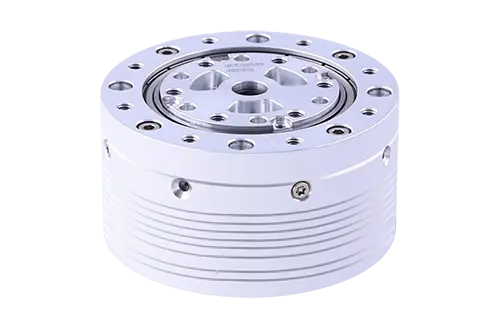
A harmonic reducer is a precision transmission mechanism based on elastic deformation and tooth engagement. A typical harmonic transmission consists of a wave generator, flexspline and circular spline.
The wave generator causes controlled deformation of the flexspline. Because the flexspline and circular spline have a small tooth-count difference, the output rotates at a substantially reduced speed relative to the input.
This architecture provides several characteristics that are particularly useful for robotic joints:
High reduction ratio in a compact package
Low backlash
High positioning repeatability
High torque density
Coaxial input and output
Compact axial dimensions
Suitable for direct integration into robot joints
High reduction ratios without requiring many conventional gear stages
Commercial harmonic gearheads are widely used in robot joints, end effectors, machine tools and mobile robotic systems. Harmonic Drive, for example, lists robot joint drive, end effectors, mobile robot wheel drives and robot arms among applications for its gearhead products.
For a robot arm, these characteristics are particularly valuable because the reducer can be integrated into a relatively small joint while maintaining a high reduction ratio.
However, harmonic transmission is not automatically the correct choice for every robot axis.
The engineer must still evaluate torque, speed, stiffness, duty cycle, shock loading, installation constraints and cost.
3. Start With the Robot Joint, Not the Reducer
One of the most common mistakes in gearbox selection is starting with a catalog.
A better engineering process starts with the robot joint.
Before comparing reducer models, define:
Robot payload
Arm segment mass
Center of gravity of each segment
Maximum joint angle
Maximum joint speed
Maximum angular acceleration
Continuous operating torque
Peak acceleration/deceleration torque
External disturbance torque
Duty cycle
Required positioning accuracy
Required repeatability
Available installation space
Maximum acceptable joint mass
Motor voltage and power
Encoder configuration
Brake requirement
Operating temperature
Expected service life
Maintenance requirements
These parameters create the actual design envelope.
Only after the envelope has been established should the engineer determine the required reducer.
4. Calculate the Required Robot Joint Torque
Torque is usually the first major sizing parameter.
For a simplified vertical robot joint, gravitational torque can be approximated as:
T = m × g × L
where:
T = gravitational torque
m = equivalent load mass
g = gravitational acceleration
L = horizontal distance between the joint axis and the load center of gravity
For a real robot arm, however, several loads may act simultaneously.
For example, a shoulder joint may need to support:
Payload
Forearm mass
Upper-arm mass
Wrist actuator mass
End-effector mass
Dynamic acceleration torque
External process force
Therefore, the actual joint torque should be calculated from the robot's complete kinematic model.
A useful engineering representation is:
T_required = T_gravity + T_acceleration + T_external + T_friction
The reducer should then be selected with an appropriate safety margin rather than operating continuously at its theoretical limit.
5. Continuous Torque vs Peak Torque
This distinction is critical.
A robot arm may require relatively low torque during normal movement but significantly higher torque during acceleration, deceleration, emergency stopping or payload manipulation.
Therefore, two different torque conditions should be considered:
Continuous torque
Continuous torque represents the thermal and mechanical load that the reducer experiences during normal operation.
Peak torque
Peak torque represents short-duration loads caused by:
Rapid acceleration
Rapid deceleration
Direction reversal
Collision events
External forces
Emergency stops
Payload changes
A reducer selected only according to continuous torque may fail to provide sufficient peak-load capacity.
Conversely, selecting an excessively large reducer simply because its peak torque rating is high can increase mass and inertia unnecessarily.
The correct solution is to compare the robot's complete torque-time profile with the reducer's allowable torque curves.
This is particularly important for humanoid robots, collaborative robots and high-dynamic robot arms where frequent acceleration and reversal can produce millions of load cycles.
6. Reduction Ratio: Do Not Automatically Choose the Highest Ratio
Reduction ratio determines the relationship between motor speed and output speed.
For example, if a motor operates at 3,000 rpm and the reducer ratio is 100:1, the theoretical output speed is approximately:
3,000 / 100 = 30 rpm
A higher reduction ratio provides more torque multiplication but reduces output speed.
Therefore, the ratio must be selected according to the desired joint motion.
A high ratio can be advantageous for:
High-load robot joints
Precision positioning
Compact high-speed motors
Applications requiring substantial torque multiplication
A lower ratio may be preferable when:
High joint speed is important
The motor already produces substantial torque
Backdrivability requirements are important
Dynamic response is prioritized
For robotic applications, the correct ratio is therefore a compromise between torque, speed, motor efficiency and control requirements.
7. Backlash Is Important, But It Is Not the Entire Accuracy Story
Backlash is one of the most frequently discussed parameters when selecting a harmonic reducer.
It describes unwanted angular play within the transmission.
For precision robot arms, excessive backlash can contribute to:
Positioning error
Direction-reversal error
Poor repeatability
Mechanical oscillation
Reduced trajectory accuracy
Harmonic transmission is attractive because its operating principle can provide extremely low backlash. Harmonic Drive documentation describes its harmonic gearing as providing zero-backlash characteristics at the gear interface, while its gearhead products specify very low angular error characteristics.
But engineers should distinguish between gearbox backlash and total robot-system error.
Even if the reducer has almost zero backlash, the robot can still exhibit positioning errors because of:
Structural deformation
Bearing deflection
Output flange deformation
Gearbox torsional compliance
Motor shaft elasticity
Encoder mounting errors
Thermal expansion
Robot-link deformation
Control-loop limitations
This is why simply choosing a reducer with the smallest published backlash value does not necessarily produce the most accurate robot.
8. Torsional Stiffness Can Be More Important Than Backlash
For high-performance robot arms, torsional stiffness deserves particular attention.
Consider a robot joint under load.
The reducer may have virtually no mechanical backlash, but if the transmission system twists significantly under torque, the output position can still deviate from the commanded position.
This is a compliance problem rather than a conventional backlash problem.
Torsional stiffness can be represented as:
K = T / θ
where:
K = torsional stiffness
T = applied torque
θ = torsional angular displacement
The higher the stiffness, the smaller the angular deformation under a given torque.
Harmonic Drive's engineering documentation describes the relationship between applied output torque and torsional angle and identifies stiffness as a key parameter for servo performance.
For robot arms, high torsional stiffness is especially valuable for:
High-precision assembly
Welding
Polishing
Force-controlled manipulation
High-speed pick-and-place
Heavy payload positioning
Multi-axis coordinated motion
Therefore, when comparing two reducers, an engineer should not ask only:
Which one has lower backlash?
The better question is:
Which transmission produces the required combination of backlash, lost motion and torsional stiffness under the actual operating load?
9. Harmonic Reducer Weight Is a Major Robot Design Parameter
Mass is particularly important in robot arms because the reducer itself becomes part of the moving mechanism.
If a reducer is installed close to the base, its mass may have a moderate effect on downstream joints.
If it is installed near the wrist, its mass can have a much larger effect.
For example, a heavy wrist actuator becomes a load for the preceding elbow joint. The elbow must then generate additional torque to move the wrist actuator. This additional torque can propagate toward the shoulder.
The result is a cascading effect:
Higher joint mass → higher upstream torque → larger actuator → higher robot mass → higher energy consumption
This is one reason why compact and lightweight transmission systems are attractive for modern robotic architectures.
Harmonic Drive's technical material similarly emphasizes the importance of low mass in robot arms because heavier transmission systems increase moving inertia and reduce available payload and acceleration capability.
For humanoid and legged robots, the mass penalty can become even more significant because every additional gram in a distal joint affects the entire dynamic system.
10. Torque Density: A Better Metric Than Torque Alone
Torque rating alone does not tell the complete story.
Two reducers may provide similar output torque while having very different weights and dimensions.
For robot applications, engineers should therefore consider:
Torque density = Available torque / Reducer mass
A compact reducer with high torque density can enable:
Higher robot acceleration
Lower joint inertia
Greater payload-to-weight ratio
Smaller motor requirements
More compact mechanical structures
Lower energy consumption
This is particularly relevant to:
Humanoid robots
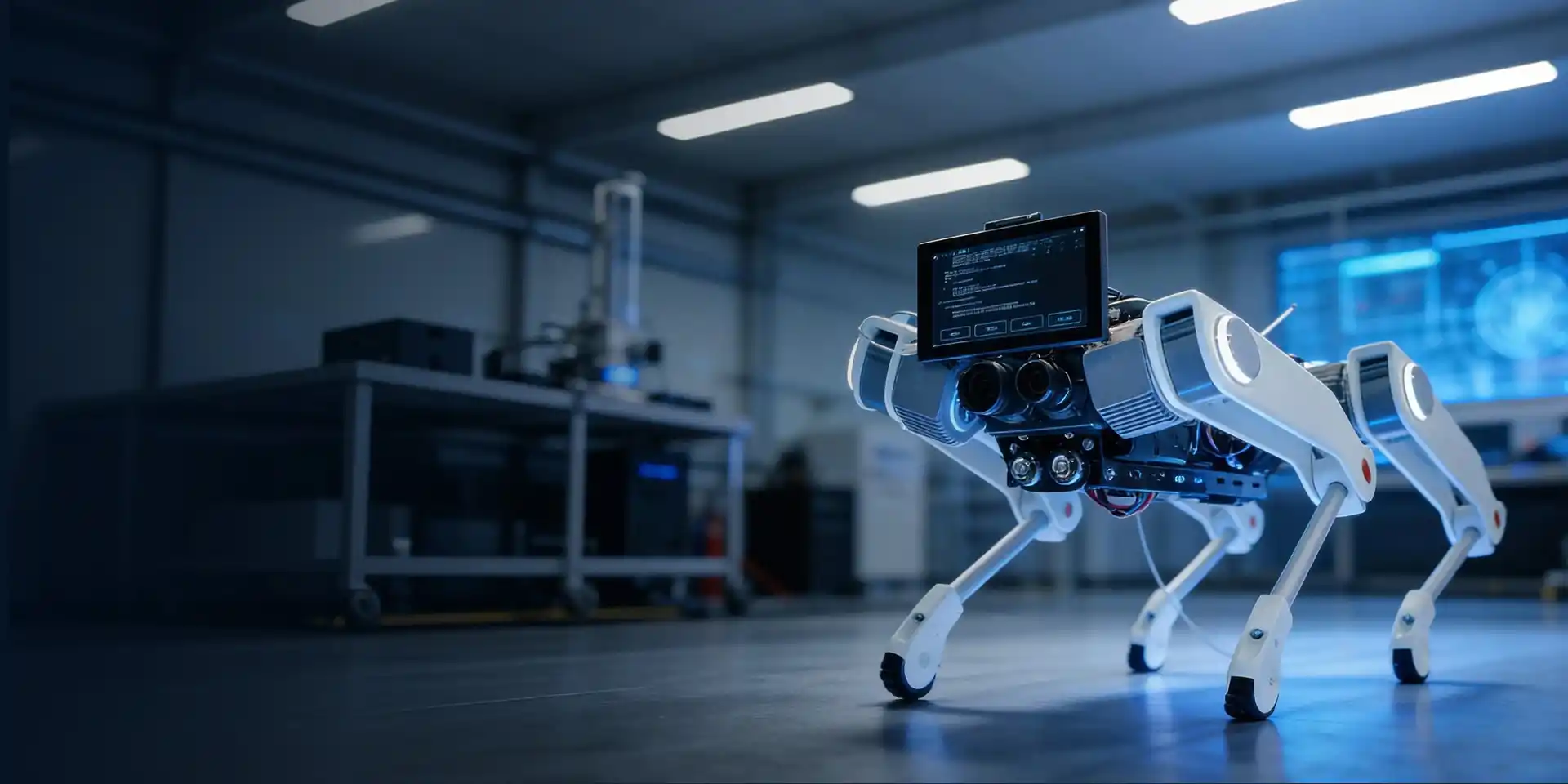
Quadruped robots
Collaborative robot arms
Lightweight industrial manipulators
Exoskeleton systems
Mobile robot joints
Liangzhi Joint's product portfolio is positioned around this type of robotic transmission architecture, including harmonic joint modules, planetary joint modules, harmonic reducers and planetary reducers.
11. Harmonic Reducer vs Planetary Reducer for Robot Arms
A harmonic reducer is not always the best transmission technology.
Planetary reducers can provide excellent torque density, stiffness and efficiency and are widely used in servo systems and industrial automation.
The correct choice depends on the robot axis.
Harmonic reducers are generally attractive when:
Very low backlash is required
Compact joint dimensions are important
High reduction ratios are required
Precision positioning is critical
Direct robot-joint integration is preferred
Low mass is important
Planetary reducers may be preferable when:
Very high torque is required
High torsional stiffness is important
High input speed is required
High efficiency is prioritized
Shock loading is significant
A different mechanical architecture is preferred
Established precision gearbox suppliers such as Neugart and STOBER demonstrate how planetary gearboxes can achieve low backlash while providing substantial torque and stiffness. Neugart's current precision gearbox portfolio, for example, includes configurations with torsional backlash ranging from approximately 1 to 8 arcmin depending on series and configuration.
STOBER's planetary servo gearboxes similarly emphasize low backlash, high stiffness and different bearing configurations for radial and axial loads.
This means a robot manufacturer should not treat "harmonic" and "planetary" as competing technologies in every situation.
A better strategy is to match the transmission architecture to the joint.
12. How Major Precision Gearbox Brands Compare
The global precision transmission market contains several established European and Japanese brands, each with different technical strengths.
WITTENSTEIN alpha
WITTENSTEIN alpha is strongly associated with high-precision planetary gearheads for demanding servo and automation applications.
Its positioning is particularly relevant where engineers require very high positioning accuracy, stiffness and repeatable servo motion.
For applications such as high-end CNC equipment, precision automation and demanding servo systems, this type of planetary architecture can be highly attractive.
However, robot manufacturers developing lightweight integrated joints may have requirements beyond the conventional gearbox itself, including motor integration, encoder packaging, hollow cabling, brake integration and compact joint geometry.
This is where a dedicated robotic joint module architecture can provide a different engineering approach.
Neugart
Neugart offers a broad range of precision planetary gearboxes. Its current product information highlights low-backlash gearboxes and configurations below 1 arcmin for selected frame sizes and configurations.
Neugart is therefore an important benchmark when evaluating precision planetary transmission.
Its strengths include:
Precision planetary architecture
Broad product range
Servo compatibility
High torque capability
Low-backlash options
Industrial automation experience
For robot manufacturers, however, the decision may ultimately depend on whether the application requires a standalone gearbox or a more integrated joint solution.
STOBER
STOBER focuses strongly on precision servo gearboxes and industrial motion systems.
Its planetary P series, for example, offers multiple ratio and bearing configurations and emphasizes low backlash, smooth operation and high stiffness.
STOBER also emphasizes that total lost motion must be considered together with backlash and torsional stiffness.
This is an important engineering principle for robot-arm design.
SEW-Eurodrive
SEW-Eurodrive is known for broad industrial drive-system coverage and modular drive architecture.
Its strengths are particularly relevant to:
Factory automation
Conveying
Packaging
Material handling
General industrial machinery
For a robot manufacturer, however, the requirements of a compact high-dynamic robot joint may be different from those of a conventional industrial drive.
A robotic joint often needs the motor, reducer, encoder, brake and control system to fit inside a very constrained mechanical envelope.
Lenze
Lenze has strong capabilities in automation, motion control and mechatronic drive systems.
Its value is particularly apparent where the gearbox forms part of a larger automation architecture.
However, robot manufacturers developing proprietary robot platforms may prioritize dedicated joint-level mechanical integration rather than a general-purpose automation drivetrain.
Bosch Rexroth
Bosch Rexroth offers extensive drive, automation and motion technologies and is particularly strong in integrated industrial systems.
For complex automation applications, the ability to combine drive technology, controls and mechanical transmission can be a significant advantage.
For robot joint developers, however, the key question remains whether the selected transmission matches the mechanical envelope, mass target, torque density and joint architecture of the robot.
Nidec-Shimpo
Nidec-Shimpo is another important reference in precision gear transmission, particularly for compact motion applications.
Its product positioning makes it relevant to engineers looking for compact and cost-conscious precision transmission solutions.
Again, the final selection should be based on actual load, speed, stiffness and lifetime requirements rather than brand reputation alone.
Sumitomo
Sumitomo has extensive experience in industrial gear transmission and applications requiring durability and robust torque transmission.
Its products are particularly relevant to heavy-duty industrial environments.
However, the requirements for a lightweight robot arm can differ substantially from those of mining, heavy machinery or other high-load applications.
13. Where Liangzhi Joint Fits Into This Competitive Landscape
Liangzhi Joint approaches robotic transmission from the perspective of core robot joint components rather than general-purpose industrial gearboxes.
According to the company's official information, Liangzhi Joint specializes in robotic joint modules and harmonic reducers and combines R&D centers in Hangzhou and Shenzhen with production bases in Zhejiang and Dongguan. The company also states that its high-precision planetary reducers can achieve accuracy down to 1 arcminute and that it holds more than 30 national patents.
Its product matrix includes:
Harmonic joint modules
Planetary joint modules
Harmonic reducers
Planetary reducers
Integrated quasi-direct-drive motor modules
This product structure is significant because robot manufacturers do not always need only a standalone reducer.
They may need a complete joint transmission module.
14. Why an Integrated Joint Module Can Simplify Robot Development
A conventional robot actuator may require separate:
Motor
Reducer
Encoder
Brake
Drive
Housing
Bearings
Wiring
Connectors
Every additional component introduces integration work.
The engineering team must determine:
Mechanical interfaces
Shaft alignment
Encoder positioning
Thermal management
Cable routing
Control compatibility
Structural packaging
Assembly tolerances
An integrated joint module can reduce this complexity by bringing several functions into one mechanical-electrical package.
Liangzhi Joint's harmonic integrated joint module is positioned as a drive-control integrated solution, with features such as hollow cabling, FOC control, EtherCAT/CANopen communication and power-off braking described on its product pages.
For a robot manufacturer, this architecture can reduce development work at the joint level.
15. Hollow-Shaft Design and Robot Cable Management
Cable routing becomes increasingly difficult as robot joint count increases.
A hollow-shaft architecture can allow cables to pass through the joint rather than routing them externally.
This can improve:
Cable protection
Mechanical appearance
Joint packaging
Rotation management
Maintenance accessibility
Robot arm compactness
Liangzhi Joint's product information specifically highlights hollow cabling in its integrated joint architecture.
For humanoid robots, collaborative robots and compact robotic arms, this can be particularly valuable because cables and connectors must fit inside increasingly constrained joint structures.
16. Brake Selection for Vertical Robot Axes
A brake should not be treated as an optional accessory when designing vertical robot joints.
If a vertical axis loses motor power, gravity may cause the joint to rotate.
This can create:
Payload drop
Mechanical damage
Safety hazards
Position loss
Therefore, a power-off brake can be important for certain robot axes.
Liangzhi Joint's integrated joint product information describes a pin-type brake mechanism designed to mechanically lock the joint after power loss, with an action time stated as less than 10 ms for the referenced product architecture.
However, the brake must still be sized according to the actual static and dynamic load.
The engineer should evaluate:
Brake holding torque
Emergency stopping requirements
Thermal capacity
Engagement time
Duty cycle
Wear
Fail-safe behavior
17. Encoder Resolution Does Not Replace Mechanical Precision
High-resolution encoders are valuable, but they cannot completely compensate for mechanical deficiencies.
Suppose a reducer has excessive torsional compliance. The encoder can detect motor-side position accurately, but the robot's output flange may still move differently under load.
Therefore, robotic accuracy should be considered at multiple levels:
Motor position → reducer transmission → output flange → robot structure → tool center point
If the application requires extremely high positioning accuracy, engineers should consider whether the encoder should measure motor position or output-side position.
This distinction becomes especially important for:
Force control
High-precision assembly
Semiconductor handling
Vision-guided manipulation
Medical robotics
Precision laboratory automation
18. Joint Positioning Accuracy vs Robot Repeatability
These terms should not be confused.
Positioning accuracy
The difference between commanded position and actual position.
Repeatability
The ability to return to the same position repeatedly.
A robot may have excellent repeatability but mediocre absolute accuracy.
This can happen because the robot has stable but systematic geometric errors.
A reducer contributes to both, but the robot's final performance also depends on calibration, structural stiffness, encoder accuracy and control algorithms.
Liangzhi Joint states that its harmonic joint module can achieve positioning accuracy of 20 arcseconds, while its planetary joint module is specified with positioning accuracy of ≤5 arcminutes on the referenced company page.
These specifications should be evaluated together with the robot manufacturer's own system-level requirements.
19. Dynamic Response and Robot Motion Quality
A robot arm is not simply a positioning mechanism.
It is a dynamic system.
During operation, the joint repeatedly accelerates, decelerates and changes direction.
A transmission with inappropriate inertia or insufficient stiffness may cause:
Overshoot
Vibration
Settling delay
Servo instability
Trajectory deviation
This is why reducer inertia, torsional stiffness and friction should be included in servo tuning.
The motor and reducer must be considered together.
For example, selecting an extremely high-ratio reducer without considering motor inertia may create a system that produces sufficient static torque but responds poorly during fast motion.
20. Thermal Performance Should Be Part of Reducer Selection
A reducer can meet its mechanical torque specification while still being unsuitable for continuous operation because of thermal limitations.
Heat can originate from:
Gear friction
Bearing losses
Seal friction
Motor losses
Drive electronics
Repeated acceleration
Temperature can also affect lubrication and material behavior.
Therefore, engineers should evaluate the expected temperature rise under the actual duty cycle.
A useful test condition is not merely:
"Can the reducer survive the maximum torque?"
but:
"Can the reducer continuously perform the required motion profile without exceeding its allowable thermal limits?"
This is particularly important for compact integrated joint modules because there may be limited surface area for heat dissipation.
21. Duty Cycle and Lifetime
Robot arms can operate for millions or even tens of millions of motion cycles.
A reducer that performs well in a short laboratory test may not necessarily provide adequate long-term reliability.
The expected lifetime should be evaluated against:
Torque profile
Speed profile
Acceleration
Reversal frequency
Operating temperature
Lubrication
Bearing loads
Shock loads
Installation accuracy
For industrial robot manufacturers, lifecycle testing should ideally reproduce the actual application rather than simply testing maximum torque.
22. Radial and Axial Loads Must Be Considered
A reducer does not experience torque alone.
The output bearing may also experience:
Radial force
Axial force
Overturning moment
These loads can be particularly significant at robot wrists and end-effectors.
This is why some precision planetary gearbox manufacturers offer different bearing configurations for different radial and axial loading conditions. STOBER, for example, describes ball-bearing, angular-contact and cylindrical-roller configurations for different load requirements.
When selecting a harmonic reducer or integrated joint module, the robot designer should therefore verify:
Output torque + radial load + axial load + moment load
rather than evaluating torque in isolation.
23. How to Select a Harmonic Reducer for Different Robot Arm Axes
Different axes require different transmission priorities.
Base axis
The base axis generally carries a large portion of the robot structure.
Priority:
High torque
High stiffness
High load capacity
High reliability
Adequate reduction ratio
A larger transmission architecture may be justified.
Shoulder axis
The shoulder is often one of the most demanding joints.
Priority:
High torque density
High torsional stiffness
High peak-load capability
Low mass
High reliability
Elbow axis
The elbow must balance torque, speed and mass.
Priority:
Torque-to-weight ratio
Dynamic response
Compact dimensions
Low backlash
Adequate stiffness
Wrist axes
Wrist joints typically place greater emphasis on:
Low mass
Compact size
High positioning accuracy
Low inertia
Low backlash
High responsiveness
This is where a lightweight harmonic joint architecture can become particularly attractive.
24. Harmonic Reducers for Humanoid Robots
Humanoid robots introduce a different set of requirements.
Their joints may need to combine:
High torque density
Low mass
High dynamic response
Compact geometry
Bidirectional motion
Frequent reversal
High controllability
Integrated sensing
Safety mechanisms
The transmission is therefore not simply a reducer.
It becomes part of the robot's fundamental actuation architecture.
Liangzhi Joint's product portfolio includes both harmonic and planetary joint modules, allowing robot developers to select different transmission architectures according to joint requirements. Its website also lists a planetary joint module specifically positioned for quadruped robot applications.
This broader portfolio can be useful when a robot platform requires different transmission technologies across different joints.
25. Harmonic Reducers for Collaborative Robots
Collaborative robots place particular emphasis on compact dimensions, controllability and repeatable motion.
Typical applications include:
Assembly
Screwdriving
Inspection
Pick-and-place
Laboratory automation
Machine tending
Light material handling
For these applications, the reducer should provide predictable transmission behavior so that the servo controller can accurately regulate joint movement.
A compact harmonic joint module can reduce the number of external components and help simplify the mechanical design.
26. Harmonic Reducers for Industrial Robot Arms
Industrial robot arms often require higher duty cycles and greater payload capacity.
The selection criteria may therefore shift toward:
Continuous torque
Peak torque
Torsional stiffness
Bearing capacity
Service life
Thermal stability
Reliability
For heavy industrial axes, a planetary architecture may sometimes provide a more appropriate balance.
This is why a supplier offering both harmonic and planetary transmission solutions can provide greater design flexibility than a supplier focused on only one transmission technology.
27. When Should You Consider a Planetary Alternative?
A harmonic reducer should not automatically replace a planetary reducer.
A planetary reducer may be worth considering when:
The robot joint experiences substantial shock loads
Very high stiffness is required
High input speed is required
Efficiency is a major concern
The application requires high continuous torque
The robot architecture allows a larger transmission package
Established planetary gearbox suppliers demonstrate the performance potential of this architecture. Neugart's current precision products cover a broad range of cyclic torque and low-backlash configurations, while STOBER offers planetary gearboxes with high stiffness and multiple bearing options.
The better engineering approach is therefore:
Harmonic where harmonic is optimal. Planetary where planetary is optimal.
28. A Practical Competitor Replacement Strategy
Robot manufacturers do not necessarily need to replace an existing gearbox simply because another product is cheaper.
A technically credible replacement must demonstrate functional equivalence.
When evaluating a replacement for an established European or Japanese reducer, compare at least:
| Parameter | Existing Reducer | Candidate Reducer |
|---|---|---|
| Reduction ratio | Required ratio | Equivalent |
| Continuous torque | Application requirement | Verified |
| Peak torque | Application requirement | Verified |
| Backlash | Existing specification | Verified |
| Torsional stiffness | Existing specification | Verified |
| Efficiency | Existing specification | Verified |
| Input speed | Required speed | Verified |
| Radial load | Application load | Verified |
| Axial load | Application load | Verified |
| Moment load | Application load | Verified |
| Mass | Existing mass | Compared |
| Envelope | Existing dimensions | Compared |
| Encoder interface | Existing system | Compatible |
| Brake | Existing system | Compatible |
| Lubrication | Existing system | Verified |
| Service life | Required lifetime | Verified |
This method is much more defensible than claiming that one gearbox is universally "better."
29. Why Dimensional Compatibility Matters
A replacement reducer may have similar torque and backlash but still require significant robot redesign if the mounting interface differs.
Engineers should compare:
Bolt-circle diameter
Output flange
Input shaft
Pilot diameter
Overall length
Maximum diameter
Cable routing
Encoder location
Brake position
A mechanically compatible replacement can dramatically reduce redesign costs.
Liangzhi Joint states that its products can match the performance and dimensions of European, American, Japanese and Taiwanese benchmarks, while also offering customized transmission solutions.
For robot OEM engineering teams, dimensional compatibility can therefore be an important part of supplier evaluation.
30. Customization vs Standard Catalog Products
Standard reducers are ideal when the application fits an existing product.
However, robotic platforms frequently have unique requirements.
A custom solution may involve:
Special output flange
Customized mounting pattern
Modified cable routing
Different encoder
Integrated brake
Special lubrication
Customized motor interface
Different gear ratio
Weight optimization
Special housing geometry
Liangzhi Joint describes a customization process covering demand analysis, solution design, precision R&D, intelligent production and quality inspection. The company also states that it can customize robotic joint modules and non-standard transmission components.
This is particularly relevant for robot companies developing proprietary mechanical platforms rather than purchasing complete standardized robot arms.
31. Quality Control Is Part of Reducer Performance
Precision transmission performance depends heavily on manufacturing consistency.
Critical factors include:
Gear geometry
Tooth profile accuracy
Bearing installation
Concentricity
Runout
Material treatment
Assembly preload
Lubrication
Housing precision
A gearbox with excellent theoretical design can still perform poorly if manufacturing tolerances are uncontrolled.
Liangzhi Joint reports using high-precision machining equipment, including Mazak equipment and HAMAI gear hobbing machines, as well as Zeiss coordinate measuring machines and German tooth-profile measuring equipment. Its website also describes a multi-step quality inspection process for incoming materials and finished products.
For procurement teams, this type of manufacturing and inspection capability should be evaluated alongside the published gearbox specifications.
32. Why Delivery Capability Matters to Robot Manufacturers
For a robotics startup or rapidly expanding robot manufacturer, engineering performance is only one part of supplier selection.
Development schedules can be affected by:
Prototype lead time
Sample availability
Engineering response
Customization speed
Production scalability
Replacement-part availability
Liangzhi Joint states that its standard and customized solutions can support delivery cycles as short as 5–7 days for applicable products and that it operates two production bases and two R&D centers.
For new robot platforms, shorter iteration cycles can be valuable because mechanical design frequently changes during development.
33. A Six-Step Harmonic Reducer Selection Process
A practical selection process can be summarized as follows.
Step 1: Define the robot's load profile
Determine payload, arm mass, center of gravity and external forces.
Step 2: Calculate continuous and peak torque
Separate normal operating torque from acceleration and shock loads.
Step 3: Determine speed and reduction ratio
Select a ratio that allows the motor to operate within its efficient and controllable range.
Step 4: Evaluate precision requirements
Check:
Backlash
Lost motion
Torsional stiffness
Positioning accuracy
Repeatability
Step 5: Optimize mass and packaging
Check the reducer's weight, diameter, length, bearing structure, cable routing and motor interface.
Step 6: Validate the complete actuator
Do not stop at reducer testing.
Test:
Motor + reducer + encoder + brake + controller + mechanical arm
as one system.
34. The Most Important Selection Parameters at a Glance
For a robot-arm harmonic reducer, the following hierarchy is useful:
Critical
Continuous torque
Peak torque
Reduction ratio
Torsional stiffness
Backlash/lost motion
Output bearing capacity
Service life
Highly important
Weight
Outer diameter
Axial length
Efficiency
Maximum input speed
Thermal performance
Lubrication
Application dependent
Brake
Hollow shaft
Encoder
Integrated motor
Integrated drive
Communication interface
Environmental protection
This hierarchy prevents engineers from overemphasizing a single specification.
35. Liangzhi Joint as an Alternative for Robot Joint Development
For robot manufacturers evaluating established European and Japanese transmission brands, Liangzhi Joint represents an alternative approach centered on robotic core components.
Rather than positioning itself only as a general industrial gearbox supplier, the company focuses on:
Robotic joint modules + harmonic reducers + planetary reducers + integrated drive solutions
Its official product portfolio covers harmonic joint modules, planetary joint modules, harmonic reducers and planetary reducers.
The company also states that its harmonic joint module is designed for applications including humanoid robots and collaborative robots, while its planetary joint module targets higher-load robotic and automation applications.
This architecture allows robot developers to evaluate different transmission technologies according to the actual requirements of each axis.
36. When Liangzhi Joint May Be a Good Replacement Candidate
Liangzhi Joint can be considered during supplier evaluation when a robot manufacturer needs:
A harmonic reducer for a robotic arm
A lightweight robotic joint module
A planetary joint for higher-load axes
An integrated motor-reducer solution
Hollow-cable routing
Integrated brake options
Customized mechanical interfaces
A replacement for an existing precision transmission
Prototype-to-production support
A supplier focused on robot core transmission components
The correct evaluation should still be engineering-based.
The candidate product should pass the same validation procedure as any incumbent product.
37. Recommended Qualification Tests Before Production
Before replacing a qualified gearbox, robot manufacturers should conduct a structured validation program.
Mechanical tests
Backlash
Lost motion
Torsional stiffness
Runout
Radial load
Axial load
Peak torque
Dynamic tests
Maximum input speed
Acceleration
Deceleration
Reversal
Positioning
Repeatability
Thermal tests
Continuous operation
Maximum duty cycle
Maximum ambient temperature
Temperature rise
Reliability tests
Long-duration cycling
Repeated direction changes
Overload testing
Brake cycling
Power-loss testing
System tests
Servo tuning
Encoder feedback
Robot trajectory accuracy
Vibration
Noise
Emergency stop
This is the appropriate way to determine whether a new harmonic reducer can genuinely replace an incumbent product.
38. The Future of Robot Transmission Is Moving Toward Integrated Actuation
The evolution of robot joints is moving from standalone mechanical gearboxes toward integrated actuator modules.
A future robot joint may combine:
Motor + Reducer + Encoder + Brake + Drive + Communication + Thermal Management
inside a single compact package.
This architecture can reduce:
Wiring
Mechanical interfaces
Assembly steps
Installation volume
Integration engineering
It can also improve consistency because the motor, reducer and controller are designed as one actuator.
For humanoid robots, AMRs, AGVs, quadruped robots and collaborative robots, this trend is particularly significant.
The reducer remains the mechanical heart of the actuator, but its value is increasingly determined by how well it integrates with the complete joint.
39. Final Recommendation: Select the System, Not Just the Gearbox
So, how should you select a harmonic reducer for a robot arm?
The answer is not simply:
Choose the reducer with the lowest backlash.
Nor is it:
Choose the reducer with the highest torque rating.
A technically sound selection should balance:
Torque + Speed + Ratio + Backlash + Torsional Stiffness + Mass + Bearing Capacity + Efficiency + Thermal Performance + Lifetime + Integration
For high-precision robot arms, harmonic reducers remain one of the most attractive transmission technologies because of their compact structure, high reduction ratios and low backlash.
For higher-load or high-stiffness applications, precision planetary reducers can be an equally important option.
The most flexible robot transmission strategy is therefore not to force every joint into the same architecture. Instead, each joint should be evaluated according to its load, dynamics, precision and packaging requirements.
This is where a core-component supplier such as Liangzhi Joint can provide value. Its portfolio spans harmonic joint modules, planetary joint modules, harmonic reducers and planetary reducers, allowing robot manufacturers to evaluate multiple transmission architectures within one component platform. The company's published capabilities also include integrated drive-control joint modules, hollow cabling, FOC-based control, communication interfaces and customized robotic transmission solutions.
For engineering teams comparing Liangzhi Joint with established European and Japanese transmission brands, the best approach is a controlled technical benchmark:
Define the exact robot-joint load profile.
Calculate continuous and peak torque.
Select the appropriate reduction ratio.
Compare backlash and total lost motion.
Compare torsional stiffness under load.
Evaluate torque density and moving mass.
Verify radial, axial and moment loads.
Check motor, encoder and brake compatibility.
Validate thermal behavior and lifetime.
Perform side-by-side system testing.
Only after these steps should a purchasing decision be made.
For modern robot manufacturers, the reducer is no longer simply a passive transmission component. It is a core motion-performance component that directly influences precision, dynamics, payload, energy consumption, mechanical packaging and overall robot architecture.
That is why selecting the right harmonic reducer should begin with the robot's engineering requirements—and end with a complete joint-level validation.