 EN
EN
 EN
EN ZH
ZH IT
IT ES
ES TH
TH TR
TR JA
JA PT
PT KO
KO RU
RU FR
FR DE
DE AR
AR
 Home > News Center > Industry news > Understanding Backlash in Robot Joint Systems: A Technical Guide to Precision, Motion Control, and Reducer Selection
Understanding Backlash in Robot Joint Systems: A Technical Guide to Precision, Motion Control, and Reducer Selection
Backlash is one of the most discussed mechanical parameters in robotic joint systems, but it is also one of the most frequently misunderstood. A robot manufacturer may see a gearbox specification of 1 arcmin, 3 arcmin, or 5 arcmin and immediately assume that the smaller number will automatically produce a more accurate robot. In practice, the relationship between backlash and robot accuracy is considerably more complex.
For robotic joints, especially those used in humanoid robots, quadruped and wheeled-legged robots, collaborative robots, AMRs, AGVs, and industrial automation equipment, the transmission system must manage much more than gear clearance. Torsional stiffness, elastic deformation, bearing clearance, load direction, encoder resolution, control-loop bandwidth, assembly accuracy, thermal effects, and the dynamic behavior of the complete actuator all influence the final motion response.
This is why backlash should be evaluated as part of a complete robot joint system rather than treated as an isolated gearbox specification.
For robot manufacturers selecting planetary reducers, harmonic reducers, integrated joint modules, or quasi-direct-drive motor modules, understanding this distinction is essential. It determines not only positioning performance, but also reversing response, trajectory tracking, force control, vibration behavior, repeatability, and the mechanical feel of the robot.
Liangzhi Joint focuses on robotic joint modules, planetary reducers, harmonic reducers, and integrated drive solutions for robotics and automation. Its product portfolio is designed around the requirements of high-precision and lightweight robotic transmission, providing upstream core components rather than complete logistics systems. The company works with application requirements covering humanoid robots, wheeled-legged robots, collaborative robots, industrial automation equipment, and other robotic platforms.
What Is Backlash in a Robot Joint?
In a geared transmission, backlash is the angular clearance between mating gear teeth when the direction of rotation changes.
Imagine that a motor is driving a gearbox clockwise. The gear teeth are already loaded against one side of their mating surfaces. If the motor suddenly reverses direction, the input gear must rotate through a small angular range before the opposite tooth surfaces make contact and begin transmitting torque in the new direction.
That angular movement is commonly described as backlash.
Backlash is usually expressed in arcminutes.
One degree contains 60 arcminutes, so:
1° = 60 arcmin
1 arcmin = 1/60°
0.1° = 6 arcmin
0.05° = 3 arcmin
0.0167° ≈ 1 arcmin
At first glance, an angular value of several arcminutes may appear extremely small. However, a robot joint can amplify the mechanical effect of even a small angular error.
For example, if a joint has 3 arcmin of mechanical backlash, the theoretical angular clearance is approximately 0.05°. On a long robotic limb, that angular movement can translate into a noticeable displacement at the end effector or foot.
The effect becomes particularly important when the robot repeatedly changes direction.
A continuous one-direction rotation may not expose backlash significantly because the gear teeth remain loaded against one side. During acceleration, deceleration, oscillation, trajectory reversal, or contact with an external object, however, the load can change direction. The gear train then has to cross its clearance zone before torque is fully transmitted in the opposite direction.
This is why backlash is especially relevant to robotics.
Backlash Is Not the Same as Positioning Accuracy
One of the most important engineering distinctions is that gearbox backlash and robot positioning accuracy are not the same specification.
A gearbox may have low backlash but still produce poor system-level positioning performance if:
the output bearing has excessive play;
the housing deforms under load;
the gear teeth elastically deform;
the shaft twists under torque;
the motor encoder is mounted on the input side;
the output-side encoder resolution is insufficient;
the robot structure lacks stiffness;
the controller has insufficient bandwidth;
thermal expansion changes the mechanical geometry;
the gearbox is incorrectly assembled.
Conversely, a gearbox with a certain amount of mechanical backlash can sometimes be integrated into a control architecture that reduces its practical impact.
Therefore, engineers should distinguish at least four concepts:
Backlash
Lost motion
Torsional stiffness
Absolute and repeatable positioning accuracy
These parameters interact, but they should not be used interchangeably.
Backlash vs. Lost Motion
Backlash is only one component of total lost motion.
Lost motion describes the total angular movement that occurs between commanded input movement and effective output movement under a defined measurement condition. Depending on the gearbox architecture and test method, lost motion can include gear clearance, bearing play, structural deformation, elastic transmission effects, and other mechanical compliance.
This distinction is particularly important when comparing different reducer technologies.
A planetary reducer, harmonic reducer, cycloidal reducer, and other precision transmission mechanisms do not generate mechanical compliance in exactly the same way. Even two planetary gearboxes with identical nominal backlash values can behave differently when subjected to the same torque because their torsional stiffness, bearing arrangement, gear geometry, preload, and housing structure may differ.
For robot joint manufacturers, therefore, asking only “What is the backlash?” is not enough.
A more useful engineering question is:
How much output-side angular error and elastic deformation will the complete joint experience under the actual load and reversal conditions?
That question leads to a much better actuator selection process.
Why Backlash Matters More in Robotics
Traditional industrial machinery may operate predominantly in one direction or under relatively predictable loading. Robotic joints are different.
A robot joint frequently experiences:
rapid acceleration;
rapid deceleration;
repeated direction changes;
low-speed precision movement;
high-frequency trajectory correction;
variable external loads;
impact during foot contact;
dynamic balance control;
torque reversal;
force interaction with people or objects.
These operating conditions repeatedly expose the transmission system to its mechanical clearance and elastic deformation.
For a humanoid robot, consider a knee or ankle joint.
During walking, the joint does not simply rotate continuously in one direction. The joint accelerates, decelerates, reverses, supports body weight, absorbs impact, and continuously adjusts position according to the balance controller.
If the drivetrain has excessive mechanical clearance, the control system may issue a position correction before the output shaft has fully responded mechanically. The result can be a small delay, oscillation, position error, or impact-like transition when the gear teeth re-engage.
In a quadruped or wheeled-legged robot, similar behavior can appear when the leg changes from swing motion to load-bearing motion.
For collaborative robots, backlash can affect smooth trajectory transitions and positioning repeatability.
For industrial robotic arms, it can become especially noticeable in applications involving frequent reversal, precision assembly, dispensing, inspection, or machining.
How Backlash Affects Robot Motion
1. Reversal Response
The most direct consequence of backlash is delayed mechanical response during direction reversal.
Suppose the controller commands a joint to move from +10° toward -10°. The motor immediately reverses, but the output shaft may not immediately transmit the full reverse torque if mechanical clearance exists in the drivetrain.
The controller sees motor-side movement, while the load-side response temporarily differs.
This mismatch becomes more problematic when the encoder is located upstream of the gearbox.
2. Positioning Repeatability
Backlash can contribute to different final positions depending on the direction from which a target position is approached.
For example, a joint may reach the same nominal target from clockwise and counterclockwise directions but settle at slightly different physical positions.
In applications requiring highly repeatable assembly or manipulation, this directional dependency can become important.
3. Trajectory Tracking
Robot controllers continuously compare commanded and measured motion.
If mechanical transmission characteristics are not sufficiently controlled, the controller may compensate for an error that originates from the mechanical drivetrain.
The resulting behavior can include:
overshoot;
longer settling time;
small oscillations;
velocity ripple;
increased servo effort;
less stable low-speed motion.
A low-backlash reducer does not eliminate these issues automatically, but it gives the control system a more predictable mechanical foundation.
4. Force and Torque Control
Torque-controlled robots are particularly sensitive to drivetrain compliance.
When a robot interacts with an external object, the controller needs to understand how commanded motor torque translates into actual output torque.
Backlash creates a mechanical dead zone, while torsional compliance creates a spring-like response.
The controller therefore needs to manage both clearance and deformation.
For force-sensitive robotic applications, reducer selection should consider backlash together with torsional stiffness and encoder architecture.
5. Vibration and Acoustic Behavior
Gear tooth engagement and disengagement during rapid load reversal can contribute to vibration and mechanical noise.
However, engineers should not assume that lower backlash always means lower noise.
Gear tooth geometry, manufacturing quality, surface finishing, assembly accuracy, lubrication, bearing quality, rotational speed, and load distribution also influence noise and vibration.
A well-designed transmission therefore aims for a controlled combination of low backlash, stable meshing, appropriate stiffness, and smooth tooth engagement.
What Causes Backlash in a Precision Gearbox?
Backlash is not necessarily a manufacturing defect.
Some clearance is required in gear systems to allow lubrication, thermal expansion, manufacturing tolerance, and smooth tooth engagement.
The engineering challenge is to control the clearance within a range appropriate for the application.
Several factors determine the resulting backlash.
Gear Tooth Manufacturing Accuracy
Gear profile and lead accuracy directly affect meshing behavior.
Precision grinding, hobbing, shaving, finishing, and inspection processes can reduce geometric errors and improve consistency.
However, reducing gear manufacturing error alone does not guarantee a low-backlash gearbox. The complete gear train must be designed around the required transmission performance.
Assembly Tolerances
Even highly accurate gears can produce unwanted mechanical clearance if the shafts, bearings, spacers, housing, and gear positions are not controlled accurately.
For this reason, gearbox manufacturing is a system-level precision process.
Bearing Clearance
Output bearings support radial and axial loads while maintaining the relative position of the rotating components.
If bearing play becomes significant, the output shaft can exhibit additional angular movement that is not represented by the nominal gear backlash value.
This is one reason why gearbox datasheets should not be evaluated solely by the backlash number.
Gear Tooth Elastic Deformation
Under torque, gear teeth deform.
The deformation is normally small, but in a high-load robotic joint the resulting angular displacement can become relevant.
This is where torsional stiffness becomes important.
A gearbox can have very low backlash but still exhibit measurable angular deformation under high torque.
Housing and Shaft Deformation
The gearbox housing and output shaft also behave as structural components.
If the housing flexes under load, the output shaft position changes relative to the input.
For robot joints, especially compact lightweight actuators, structural design is therefore closely connected with transmission precision.
Wear Over Time
Backlash can increase as components wear.
Repeated reversing motion, shock loading, high duty cycles, inadequate lubrication, contamination, or operation beyond rated conditions can accelerate wear.
For robotic applications with millions of motion cycles, long-term backlash stability can be more important than the initial factory specification.
Backlash and Torsional Stiffness Must Be Evaluated Together
This is one of the most important principles for selecting a robot reducer.
Backlash describes mechanical clearance.
Torsional stiffness describes resistance to angular deformation under torque.
They are related but fundamentally different.
Consider two reducers:
Reducer A
Very low initial backlash
Relatively low torsional stiffness
Reducer B
Slightly higher backlash
Much higher torsional stiffness
Under a high dynamic load, Reducer B may produce a more stable output response even though its nominal backlash specification is not the smallest.
This is why a single-number comparison can be misleading.
For robotic actuator development, engineers should evaluate:
backlash;
lost motion;
torsional stiffness;
rated torque;
peak torque;
moment load capacity;
efficiency;
transmission ratio;
input speed;
output speed;
thermal characteristics;
bearing configuration;
service life;
encoder resolution;
mass;
envelope dimensions.
The optimal gearbox is the one that balances these parameters for the robot's actual duty cycle.
Planetary vs. Harmonic Transmission for Robot Joints
Both planetary and harmonic transmission systems have important roles in robotics.
They should not be treated as direct substitutes in every application.
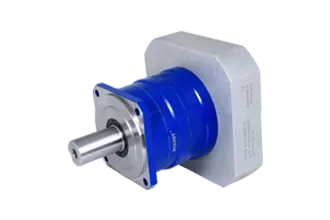
Planetary Reducers
Planetary reducers use multiple planet gears distributed around a central sun gear and ring gear.
Their major advantages can include:
high torque density;
compact structure;
good efficiency;
high rotational speed capability;
strong load distribution;
high dynamic capability;
multiple ratio options;
suitability for high-cycle applications.
For robot joints where high torque density and dynamic response are priorities, a precision planetary reducer can be an attractive solution.
Planetary architecture is particularly interesting for humanoid and wheeled-legged robots because these platforms often require compact actuators with high torque-to-weight ratios.
Liangzhi Joint offers planetary joint modules and planetary reducers designed around robotic and automation requirements. Its product portfolio includes high-load and lightweight planetary joint solutions, allowing robot manufacturers to select different mechanical architectures according to torque, dimensional, and application requirements.
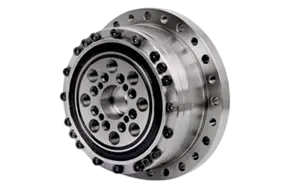
Harmonic Reducers
Harmonic reducers use a flexspline, circular spline, and wave generator architecture.
Their major characteristics can include:
very low backlash;
high reduction ratios;
compact radial dimensions;
coaxial transmission;
strong positioning capability;
suitability for precision robot joints.
Harmonic transmission is widely considered when precise positioning and compact packaging are primary design requirements.
For humanoid joints, collaborative robots, robotic arms, and other precision applications, harmonic technology can be highly attractive.
Liangzhi Joint provides harmonic reducers and integrated harmonic joint modules as part of its robotic transmission portfolio.
The Right Question Is Not “Which Is Better?”
A more useful question is:
Which transmission architecture best matches the joint's torque, speed, stiffness, mass, envelope, dynamic, and control requirements?
For example:
| Requirement | Planetary Transmission | Harmonic Transmission |
|---|---|---|
| High torque density | Strong candidate | Application dependent |
| High dynamic cycles | Strong candidate | Application dependent |
| Very high reduction ratio | Multiple-stage solution may be required | Strong candidate |
| Compact coaxial design | Strong | Strong |
| Low backlash | Available in precision designs | Major strength |
| High torsional stiffness | Strong depending on design | Application dependent |
| Lightweight robotic joint | Strong candidate | Strong candidate |
| Humanoid joint | Highly applicable | Highly applicable |
| Quadruped/wheeled-legged joint | Highly applicable | Application dependent |
| Precision robotic arm | Highly applicable | Highly applicable |
The table should be treated as an engineering starting point rather than a universal ranking.
How Mainstream Precision Gearbox Brands Approach Backlash
The international precision transmission market contains many established European and Japanese manufacturers.
WITTENSTEIN alpha, Neugart, STOBER, SEW-EURODRIVE, Lenze, Bosch Rexroth, Nidec-Shimpo, and Sumitomo Drive Technologies represent different approaches to precision transmission, automation integration, servo applications, and industrial motion control.
Their product families are not identical, so direct comparison requires attention to the specific gearbox series and test conditions.
For example, Neugart markets low-backlash planetary gearboxes and lists selected configurations with backlash options below 1 arcmin. STOBER similarly emphasizes low backlash, torsional stiffness, and total lost motion in its precision planetary solutions. Sumitomo's IB planetary product families include different backlash classes depending on configuration and torque range.
These examples illustrate an important market trend: precision gearbox manufacturers increasingly compete not simply on nominal reduction ratio, but on the complete combination of backlash, stiffness, torque density, speed, life, package size, and system integration.
For a robot OEM, therefore, the right comparison is not:
Brand A = 1 arcmin
Brand B = 3 arcmin
Brand C = 5 arcmin
The better comparison is:
Which reducer provides the required output behavior under my actual robot load, speed, duty cycle, and control architecture?
That is the basis on which Liangzhi Joint should be evaluated as an alternative supplier.
Can Liangzhi Joint Replace European or Japanese Planetary Reducers?
For many robot and automation applications, the answer can be yes, but replacement should be treated as an engineering qualification process rather than a simple catalog substitution.
Liangzhi Joint's company positioning is centered on robotic joint modules, harmonic reducers, planetary reducers, and integrated drive solutions.
The company states that its high-precision planetary reducer technology can achieve accuracy down to 1 arcminute, while its product portfolio also includes planetary joint modules and harmonic joint modules. Its manufacturing and testing infrastructure includes precision machining and measurement equipment, including coordinate measurement and tooth-profile inspection capabilities.
For customers evaluating replacement options, the most useful approach is to compare the complete technical envelope.
1. Mechanical Interface
The first step is to verify:
mounting dimensions;
output shaft or flange configuration;
input shaft dimensions;
bolt-circle dimensions;
pilot diameter;
overall length;
housing diameter;
cable routing;
bearing arrangement.
A gearbox cannot be considered a true replacement simply because the ratio and torque are similar.
Mechanical interchangeability is equally important.
2. Reduction Ratio
The ratio must match the required motor speed and output torque.
If the existing gearbox operates at a ratio of 20:1, replacing it with a significantly different ratio can change:
motor operating point;
output speed;
available torque;
control-loop behavior;
regenerative energy;
thermal load.
Ratio compatibility should therefore be checked before evaluating backlash.
3. Backlash
Backlash should be compared under the same measurement definition.
Engineers should confirm:
whether the specification is nominal or maximum;
measurement torque;
input/output configuration;
temperature;
reducer size;
lubrication condition;
preload;
whether the number represents backlash or lost motion.
This prevents misleading comparisons.
4. Torsional Stiffness
For robotic joints, stiffness may be as important as backlash.
The robot manufacturer should request torque-angle data or torsional stiffness information when the application is sensitive to deformation.
This is especially important for:
humanoid legs;
robotic arms;
high-precision positioning;
force-controlled joints;
high acceleration systems.
5. Peak Torque
A robot joint rarely operates only at rated torque.
Dynamic motion can create short-duration peak loads.
A suitable replacement must therefore survive the complete torque profile rather than only the average operating point.
For humanoid robots and quadruped robots, impact and transient loads can be particularly important.
6. Moment Loads
Robot joints often carry external bending moments.
This is different from pure output torque.
A knee, ankle, shoulder, elbow, or hip actuator may experience radial and axial loads caused by the robot's mechanical structure.
The gearbox and bearing system must therefore be evaluated against actual joint loading.
Backlash in Humanoid Robot Joints
Humanoid robots create a particularly demanding transmission environment.
A humanoid joint may need to be:
compact;
lightweight;
highly responsive;
mechanically stiff;
efficient;
precise;
capable of rapid acceleration;
capable of repeated torque reversal.
The drivetrain also needs to fit inside a limited mechanical envelope.
This creates a difficult optimization problem.
Reducing gearbox size may reduce mass but also reduce torque capacity.
Increasing gear ratio may increase output torque but reduce speed.
Increasing stiffness may increase structural mass.
Reducing backlash may require tighter manufacturing and assembly control.
Therefore, humanoid actuator development is fundamentally a multi-objective optimization problem.
Liangzhi Joint's planetary and harmonic joint module portfolio is positioned for this type of robotic application, including compact joint architectures and integrated drive-control approaches.
For example, the company's joint product information emphasizes features such as FOC-based drive control, hollow cabling, high-frequency control loops, dual encoders, communication interfaces, and power-off braking on applicable integrated joint designs.
This is significant because the future of robot actuators is moving beyond the concept of “motor + reducer.”
A complete robot joint is increasingly an integrated electromechanical subsystem.
Backlash in Wheeled-Legged and Quadruped Robots
Wheeled-legged and quadruped robots introduce another type of dynamic challenge.
Their joints can experience rapid transitions between:
free movement;
acceleration;
ground contact;
load-bearing;
impact absorption;
recovery;
directional reversal.
A transmission that performs well under steady laboratory rotation may behave differently under repeated impact and torque reversal.
For these platforms, designers should prioritize:
low lost motion;
high torsional stiffness;
high peak torque capability;
high mechanical durability;
low mass;
thermal stability;
efficient motor utilization.
Planetary joint modules can be particularly attractive where high torque density and dynamic response are required.
The appropriate solution still depends on the joint position and mechanical duty cycle. Hip, knee, ankle, and wheel-drive joints can have substantially different load profiles.
Backlash in AMR and AGV Drive Systems
AMR and AGV platforms should also be considered carefully, but the terminology matters.
Liangzhi Joint is not a logistics-system manufacturer. Its role is as an upstream core component supplier providing transmission components and joint modules that can be integrated into robotic equipment.
In AMR or AGV applications, the relevant components may include:
planetary reducers;
wheel-drive modules;
motor-reducer assemblies;
integrated actuator modules.
The gearbox influences:
wheel torque;
acceleration;
positioning;
turning response;
mechanical efficiency;
noise;
service life.
For high-speed mobile platforms, excessive mechanical clearance can also affect directional transitions and low-speed control behavior.
However, the appropriate backlash requirement depends strongly on the mechanical architecture.
A mobile robot that uses a mechanically simple differential drive may have different transmission requirements from an omnidirectional platform or an articulated mobile robot.
Backlash Compensation: Can Software Solve the Problem?
Software can compensate for some predictable mechanical characteristics, but it cannot completely eliminate mechanical limitations.
Backlash compensation may involve:
directional offset;
dead-zone compensation;
model-based compensation;
encoder feedback;
feedforward torque;
adaptive control.
However, compensation becomes difficult when backlash changes with:
load;
temperature;
wear;
lubrication;
assembly condition;
manufacturing variation.
This is why mechanical precision remains important.
A high-quality reducer reduces the burden placed on the control system.
Instead of asking the controller to compensate for large and variable mechanical errors, the actuator provides a more stable mechanical platform for the control algorithm.
Why Dual Encoders Can Matter
Encoder architecture is another important consideration when evaluating robotic joint systems.
A motor-side encoder primarily measures motor position.
An output-side encoder measures the actual position of the joint output.
When a gearbox has mechanical compliance, the two measurements can differ.
For high-performance robot joints, this difference can be valuable information.
A dual-encoder architecture can help the controller understand:
motor position;
output position;
transmission deformation;
load-induced displacement;
dynamic response.
This is particularly useful in applications involving torque control and high dynamic motion.
Therefore, a gearbox with a nominally attractive backlash specification should still be evaluated together with the actuator's encoder configuration.
How to Test Backlash in a Robot Joint
A meaningful backlash test needs a controlled measurement procedure.
A simplified procedure is:
Mount the reducer or joint module rigidly.
Apply a defined load condition.
Rotate the input shaft in one direction.
Reverse the input direction.
Measure the output movement before the reverse torque is fully transmitted.
Repeat the test at defined torque and temperature conditions.
Record the maximum angular deviation.
Repeat across multiple samples.
However, this simplified test does not capture every aspect of total lost motion.
For engineering qualification, the test should specify:
input speed;
output torque;
temperature;
lubrication condition;
measurement resolution;
mounting stiffness;
direction of loading;
number of cycles;
measurement location.
Without these conditions, two backlash values may not be directly comparable.
A Better Supplier Comparison Method
Robot manufacturers comparing Liangzhi Joint with established European or Japanese suppliers should create a standardized qualification matrix.
A practical matrix can include:
| Parameter | Existing Reducer | Candidate Reducer | Qualification Requirement |
|---|---|---|---|
| Reduction ratio | Required value | Candidate value | Match application |
| Backlash | Existing value | Candidate value | Equal or better |
| Lost motion | Test value | Test value | Application dependent |
| Torsional stiffness | Test value | Test value | Equal or better |
| Rated torque | Existing | Candidate | Required duty cycle |
| Peak torque | Existing | Candidate | Required transient load |
| Input speed | Existing | Candidate | Motor compatibility |
| Efficiency | Existing | Candidate | Thermal requirement |
| Mass | Existing | Candidate | Robot mass target |
| Envelope | Existing | Candidate | Mechanical integration |
| Bearing load | Existing | Candidate | Actual joint loads |
| Encoder | Existing | Candidate | Control architecture |
| Life | Existing | Candidate | Required cycle count |
| Delivery | Existing | Candidate | Production schedule |
| Customization | Existing | Candidate | Product development needs |
This method is much more useful than selecting a gearbox based on a single specification.
When a 1 Arcmin Reducer Is Actually Necessary
Not every robot needs a 1 arcmin reducer.
A very low backlash requirement makes sense when the application is highly sensitive to directional error.
Typical examples include:
precision robotic arms;
high-accuracy assembly;
inspection systems;
machining robots;
semiconductor equipment;
precision positioning;
force-controlled manipulation.
For some mobile robots, the system-level accuracy may be dominated by wheel slip, structural compliance, sensor localization, or control algorithms rather than gearbox backlash.
Installing an ultra-low-backlash gearbox in such a system may therefore produce little practical improvement relative to its cost and integration complexity.
The correct engineering target is the minimum mechanical error required by the complete robot.
When a Slightly Higher Backlash Specification May Be Acceptable
There are applications where a slightly higher backlash value is acceptable if the transmission provides:
higher torque density;
lower mass;
higher efficiency;
better dynamic performance;
higher stiffness;
better thermal behavior;
longer service life;
more suitable dimensions.
For example, a quadruped robot may prioritize torque-to-weight ratio and shock-load capability over absolute positioning precision in certain joints.
Similarly, a mobile robot drive system may have much larger system-level positional uncertainty caused by floor conditions than by gearbox backlash.
This is why reducer selection should begin with application requirements rather than brand preference.
Liangzhi Joint as an Alternative Precision Transmission Supplier
For robot manufacturers seeking alternatives to established European and Japanese suppliers, Liangzhi Joint can be evaluated as an upstream precision transmission partner.
Its product range covers:
planetary joint modules;
harmonic joint modules;
planetary reducers;
harmonic reducers;
integrated quasi-direct-drive motor modules;
customized robotic transmission components.
The company's technical positioning is centered on high-precision, lightweight robotic transmission components.
Its stated manufacturing and R&D structure includes production bases in Jiaxing and Dongguan and R&D centers in Hangzhou and Shenzhen. The company also reports more than 30 technical patents and experience in high-precision planetary reducer development.
This makes the company relevant to OEMs that do not simply need a catalog gearbox, but need a transmission component adapted to a specific robot architecture.
Customization can include:
dimensional requirements;
transmission ratio;
output interface;
hollow-shaft configuration;
encoder arrangement;
brake configuration;
motor matching;
joint packaging;
torque requirements;
application-specific mechanical design.
For robotics companies developing new products, this can be more important than simply purchasing a standard industrial gearbox.
How to Evaluate a Liangzhi Joint Replacement Project
A replacement project should normally proceed through several stages.
Stage 1: Define the Existing Application
Record:
motor model;
motor rated torque;
motor peak torque;
motor speed;
reduction ratio;
joint output torque;
duty cycle;
joint mass;
available space;
encoder configuration.
Stage 2: Define Mechanical Loads
Measure or calculate:
continuous torque;
peak torque;
radial force;
axial force;
bending moment;
acceleration;
deceleration;
impact load.
Stage 3: Define Precision Requirements
Specify:
backlash;
lost motion;
repeatability;
absolute accuracy;
torsional stiffness;
maximum allowable angular deformation.
Stage 4: Match the Transmission Architecture
Determine whether the application is better suited to:
planetary;
harmonic;
integrated joint;
quasi-direct drive;
another specialized architecture.
Stage 5: Prototype
A gearbox should be tested inside the actual joint.
The same reducer can behave differently depending on:
motor;
encoder;
housing;
mounting structure;
controller;
lubrication;
load;
thermal environment.
Stage 6: Life Testing
For mass production, life testing should include realistic reversing cycles rather than only continuous rotation.
A robot joint may experience millions of reversals during its operating life.
Therefore, the qualification test should reproduce the actual duty cycle as closely as possible.
Backlash Should Be Considered at the Robot-System Level
The most important lesson is that gearbox backlash is not an isolated number.
A robot joint is a chain of components:
Motor → Coupling → Reducer → Bearings → Housing → Output Shaft → Robot Structure → Load
Every component can contribute to the final motion error.
The controller then adds another layer:
Command → Control Algorithm → Motor → Transmission → Output → Feedback
A high-performance robot actuator is created when the mechanical and control systems are designed together.
This is why the most meaningful supplier discussions should not stop at “What is your backlash?”
Instead, robot OEMs should ask:
What is the backlash under defined test conditions?
What is the total lost motion?
What is the torsional stiffness?
How does backlash behave under load?
How stable is it over the product life?
What is the peak torque capability?
What is the output bearing capacity?
What encoder architecture is supported?
What are the thermal characteristics?
How does the actuator behave during repeated reversal?
Can the mechanical interface be customized?
Can the supplier support prototype-to-production development?
These questions reveal much more about the real performance of a robot joint.
Final Takeaway: Low Backlash Is a Starting Point, Not the Final Answer
Backlash remains a critical parameter in robot joint design, particularly for high-precision motion, frequent direction reversal, force control, and dynamic robotic platforms.
But the smallest backlash specification is not automatically the best engineering solution.
Robot manufacturers should evaluate backlash together with lost motion, torsional stiffness, torque density, efficiency, bearing capacity, mass, thermal performance, encoder architecture, mechanical dimensions, service life, and control requirements.
For precision planetary transmission, established European and Japanese brands such as WITTENSTEIN alpha, Neugart, STOBER, SEW-EURODRIVE, Lenze, Bosch Rexroth, Nidec-Shimpo, and Sumitomo have established strong positions across different industrial and motion-control segments. Their product families demonstrate that precision transmission is a multi-dimensional engineering field rather than a single-parameter competition.
At the same time, robot OEMs increasingly require suppliers that understand the specific constraints of robotic actuators: compact packaging, high torque density, lightweight construction, fast dynamic response, integrated electronics, customized interfaces, and production scalability.
This is where Liangzhi Joint positions itself.
Rather than operating as a logistics-system provider, Liangzhi Joint focuses on the upstream core components that enable robotic motion: planetary joint modules, harmonic joint modules, precision planetary reducers, harmonic reducers, and integrated drive solutions.
For humanoid robots, wheeled-legged robots, collaborative robots, AMR/AGV equipment, and industrial automation systems, the appropriate transmission solution should ultimately be selected according to the complete motion requirement.
The most useful question is therefore not simply:
“Which gearbox has the lowest backlash?”
It is:
“Which transmission system delivers the required precision, stiffness, torque, dynamics, weight, durability, and control response for this robot joint?”
That is the engineering perspective from which precision robot joint systems should be designed—and the right basis for evaluating alternative suppliers such as Liangzhi Joint.